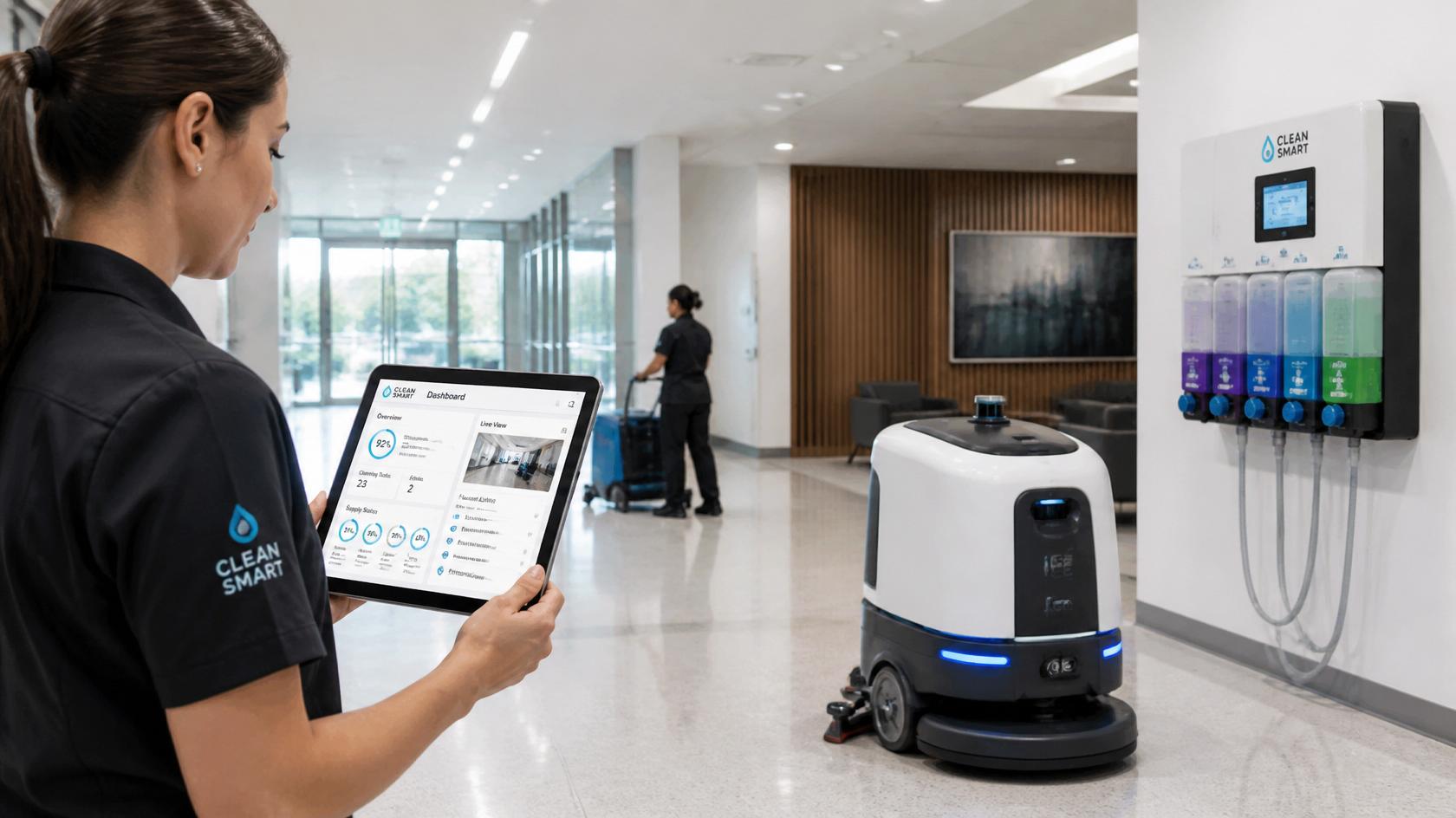
Professional cleaning equipment and smart systems representing janitorial cleaning trends shaping 2026

Janitorial Cleaning Mid-Year Update: What End Users Are Prioritizing in 2026

Picture of Laura Mahecha

Laura Mahecha

Director of Professional Cleaning, Chemicals and Materials

As the professional cleaning industry moves through 2026, end-user expectations are continuing to evolve. Sustainability, dilution and dispensing systems, smart cleaning technologies, automation, and changing workforce needs are reshaping how facilities evaluate cleaning products and programs.
Cleaning performance remains essential, but it is no longer the only measure of value. End users are increasingly assessing products and systems through a broader lens that includes efficiency, safety, sustainability, labor availability, ease of use, and measurable operational impact.
These shifts build on several themes highlighted in Kline’s earlier analysis of janitorial cleaning industry trends, where sustainability and dilution and dispensing systems were already emerging as important drivers of change.

Sustainability Is Becoming an Operational Priority

End users are placing greater emphasis on sustainability across their cleaning operations. In practice, this is reflected not only in demand for cleaner product ingredients, but also in increased use of post-recycled-content packaging, water and energy conservation, and concentrated formulas.
A majority of surveyed end users indicate a willingness to pay more for “green” cleaning products. Kline’s professional cleaning end-user survey shows that greener chemistries are the most prevalent sustainability initiative among respondents. However, sustainability efforts extend beyond chemistry: two-thirds of respondents also report reducing plastic waste and using products in recycled-content packaging. Water and energy conservation are also important initiatives connected to cleaning operations.
 
Perceptions of green cleaning performance are also changing. More than 50% of end users consider green cleaning products to be as effective as traditional janitorial cleaning chemicals, while more than 30% consider green products to be more effective. As facilities continue to pursue sustainability programs, and as local governments support these initiatives, the perceived efficacy of green cleaning products is likely to continue improving.
 
Certification remains an important signal. Around 58.4% of end users identify a green cleaning product by the green certification mark on the packaging, including certifications such as EcoLogo, Green Seal, and EPA Safer Choice.

Dilution and Dispensing Systems Support Safety, Efficiency, and Cost Control

Dilution and dispensing systems are another important area of focus for cleaning operations. These systems are often used by industrial and institutional facilities to reduce waste, improve product handling, support consistent cleaning outcomes, and help manage water and energy use.
 
An estimated 72% of recent survey respondents indicate that they use dilution and dispensing systems at their facilities. Among those users, 29% to 49% of all chemicals used are dispensed through such systems.
 
The main reasons end users rely on dilution and dispensing systems include employee safety and training, better cleaning from correct dilution, and cost efficiency. These benefits are becoming more important as facilities look for ways to simplify cleaning operations while maintaining high performance standards.
 
For suppliers and distributors, this creates opportunities to support customers with systems that improve control, reduce misuse, and help facilities balance performance, safety, and cost.

End-User Demands Are Evolving Beyond Basic Cleaning Performance

Several end-user requirements are expected to shape the professional cleaning industry through 2026. These trends reflect a market where cleaning is increasingly connected to health, operational efficiency, labor management, technology adoption, sustainability, and procurement expectations.

Heightened Health and Hygiene Standards

Post-pandemic, there is sustained demand for high-standard cleaning. Businesses continue to require certified sanitizers, and disinfectants are increasingly used alongside digital disinfection logs.
 
Cleaning is now more closely linked to well-being and indoor air quality, particularly in sectors such as healthcare and hospitality. As a result, cleaning programs are being evaluated not only on visible cleanliness, but also on the confidence they provide to employees, customers, patients, guests, and facility users.

Workforce Challenges

The professional cleaning sector continues to face labor shortages and rising workforce expectations. These pressures are influencing cleaning programs, product selection, and equipment investment.
 
Automation can help offset labor challenges, but it also requires skilled oversight. As cleaning operations become more technology-enabled, training and workforce support will remain critical to successful adoption.

Data-Driven and Smart Cleaning

Data-driven and smart cleaning systems are changing how facilities plan and execute cleaning tasks. The use of IoT and real-time monitoring is making it possible to adjust cleaning schedules based on actual facility usage rather than static routines.
 
Smart systems and AI-driven tools can help optimize cleaning operations, improve efficiency, and reduce waste. Integrated hygiene programs and digital inspection tools are also becoming more mainstream, influencing vendors to improve quality, documentation, and support for ESG reporting.

Automation, Robotics, and AI Integration

Automation is becoming a more common part of cleaning operations, particularly as facilities look for ways to address labor shortages and improve productivity. Autonomous robots and AI-enabled tools are taking on repetitive tasks, allowing human workers to focus more on supervision, quality control, and specialized cleaning roles.
 
The adoption of robotics and AI is not just a technology story. It also changes how cleaning programs are managed, how staff are trained, and how performance is measured.

Sustainability and Circular Economy

Sustainability has become a core expectation rather than a differentiator. The professional cleaning industry is adopting low-water and energy-efficient technologies, biodegradable chemicals, and circular packaging systems.
 
These practices are increasingly tied to procurement requirements and cost control. For many end users, sustainability must now deliver practical business value alongside environmental benefits.
 
This same shift is also visible in adjacent cleaning categories. In cleaning wipes, for example, sustainability and performance pressures are reshaping both chemical formulations and substrates, as explored in Kline’s article on cleaning wipes trends and the reset in chemicals and substrates.

What This Means for Suppliers and Distributors

The professional cleaning market is becoming more complex. End users are balancing traditional cleaning performance with sustainability goals, labor constraints, safety requirements, digital tracking, procurement pressure, and cost control.

For suppliers and distributors, this means product value propositions need to be broader and more clearly connected to end-user priorities. Products and systems must help facilities answer practical questions:

  • Can this product support sustainability goals without compromising performance?

  • Does this system improve safety, training, or operational control?

  • Can this solution reduce waste, water use, plastic consumption, or energy use?

  • Does it help address labor shortages or simplify cleaning procedures?

  • Can it support documentation, compliance, or ESG reporting?

The companies best positioned for the next phase of growth will be those that connect product performance with operational value.


Explore the Research Behind These Trends

Our professional cleaning research helps companies understand product usage, purchasing behavior, sustainability initiatives, dilution and dispensing system adoption, and the priorities shaping janitorial and housekeeping cleaning products.
Smart Data. Trusted Expertise. Better Decisions.