
Laura Mahecha
Director Professional Cleaning Products
While wipes are a quick and efficient way to clean surfaces, they are sometimes under scrutiny for their sustainability and degradability. Given that cleaning wipes are often constructed of microfiber, which contains plastic polymers like polyester and polyamide/nylon, and are disposed of after each use, they are not inherently eco-friendly. U.S. regulations are increasingly banning single-use plastics (SUPs). As of 2026, twelve states, including California, Colorado, Connecticut, Delaware, Hawaii, Maine, New Jersey, New York, Oregon, Rhode Island, Vermont, and Washington, all have statewide bans on SUPs. While these laws have targeted SUPs like plastic shopping bags, Styrofoam food containers, and plastic cutlery, it is not hard to imagine that these rules could apply to microfiber wipes in the not-so-distant future.
Furthermore, it has become apparent that paper and non-flushable wipes are major contributors to sewer blockages. The lack of federal regulations on using the term “flushable” on product packaging, coupled with often ambiguous disposal instructions, has prompted some states to consider enacting their own labeling laws. For example, Washington was a pioneer with its law that mandated a clear “Do Not Flush” logo on non-flushable wipe packaging, with specific requirements for the logo’s size, contrast, and placement. California, Oregon, Illinois, Washington, Massachusetts, Hawaii, and Colorado have enacted similar legislation. Despite advancements in flushability standards, bridging the consumer awareness gap regarding proper disposal remains a challenge. The California Association of Sanitation Agencies (CASA), the Responsible Flushing Alliance (RFA), and the Association of the Nonwoven Fabrics Industry (INDA) partnered to conduct a sewage collection study. The study aimed to identify the primary culprits of clogging sewer lines and equipment across the state. Surprisingly, flushable wipes, which adhere to industry-approved testing and labeling guidelines, constituted less than 1% of the items collected. In contrast, paper products accounted for 53%, and wipes marked with the “Do Not Flush” symbol comprised 34% of the issues.
As a result, the industry has innovated cleaning wipes brands with more natural fibers and more natural chemical ingredients. We have seen an increased focus on bamboo and cotton substrates, and in the future, we may see decreased microfiber wipes in favor of substrates that offer better degradability and flushability. Demand is also increasing for wipes with active ingredients that are plant-based or botanical, such as citric acid, lavender, soy, lactic acid, and thymol. Recently, suppliers have launched professional wipes that are made of plant-based active ingredients, viscose-free substrates, plant-based fibers and substrates, recycled packaging, or offer improved degradability/compostability, such as Lysol Simply by Reckitt, Clorox’s Free & Clear, and EcoClean, PDI’s Protect 360 Biodegradable Sanitizing Wipes, WypAll by Kimberly-Clark, Chicopee Microfibre by Berry Global, and Ecolab’s Disinfectant 1 Wipe is 100% plastic free, degradable hospital wipe, made from wood pulp fibers.
In fact, these innovations will resonate among professional cleaning end users who have expressed some concerns about wipes not being compatible with their sustainability and ESG goals. From a recent survey of end users who told us they are using fewer disposable wipes, we asked them to rate their level of concern when it comes to disposable wipes in relation to their ESG policy. They are somewhat concerned about disposable wipes in relation to their ESG policy. Again, waste and biodegradability are their primary concerns.
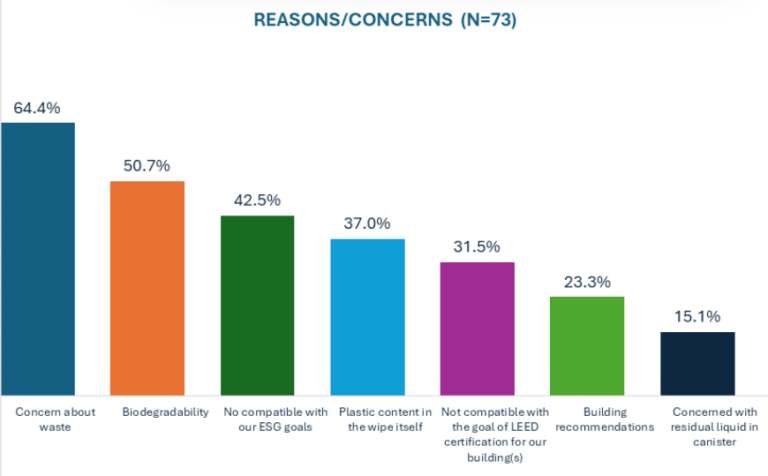
Source: Kline & Company’s Industrial and Institutional Cleaning Wipes U.S. 2024 study
Despite these concerns and regulations, one thing is certain: the professional wipes industry will continue to evolve to meet user needs and remain compliant with new regulations and sustainability and ESG goals.
This year, Kline will be conducting detailed research on both the professional finished goods I&I Cleaning Wipes 2026 U.S., as well as a deep dive into the upstream value chain for both substrates and chemical formulations in wet wipes in Material Components of Cleaning Wipes 2026, covering the U.S. and Europe. For more information on how Kline’s market intelligence can inform your company’s strategy in wipes, please contact us.