
Mohit Bhat
Director, Chemicals and Materials
Semiconductor demand is entering another major expansion cycle, driven largely by increased applications of AI and the expanding infrastructure of data centers. The industry’s ability to convert announced capacity into reliable wafer output also depends on a less visible value chain of chemicals, gases, and materials that enable each step of semiconductor manufacturing. Also, as semiconductors become more complex, they require more processing steps, which generally means more cleaning, etching, deposition, lithography, polishing, and packaging activity, each of which relies on highly controlled material inputs.
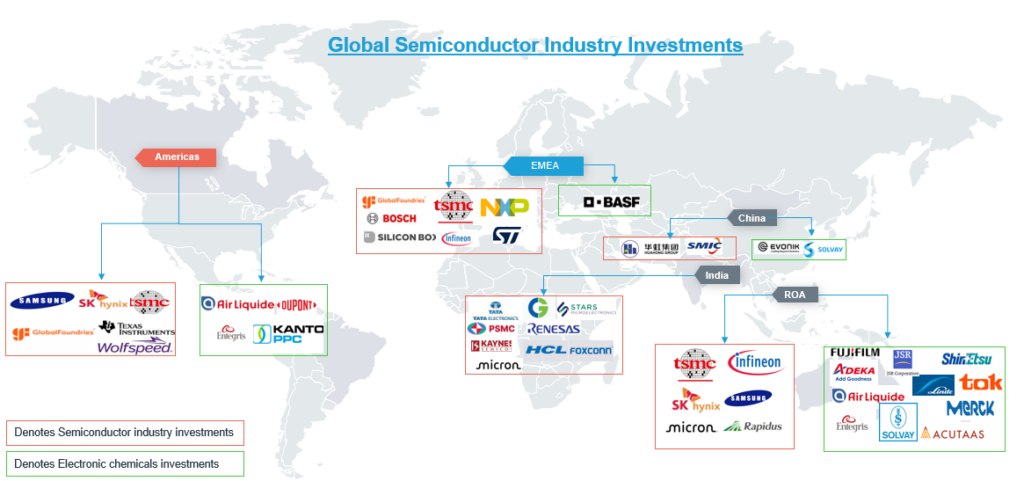
The scale of recently announced and newly operating semiconductor investment is significant, reaching nearly $2.5 trillion according to Kline’s analysis. New and expanded fabs are being pursued largely across Asia, North America, and Europe, reflecting both cyclical demand recovery and structural growth in compute-intensive applications. Key sectors driving demand include:
AI and high-performance computing
Data storage
Automotive electrification and autonomy
Industrial, communications, and consumer applications
All of this raises the central question for the materials industry: has investment in the right chemical supply chain areas kept pace with the demand for semiconductors and the wave of fab investment now underway? The answer depends not just on nominal chemical capacity, but on whether suppliers can provide electronic-grade materials with the required purity, quality control, logistics resilience, regional availability, and customer qualification history.
The semiconductor materials value chain, seen below, begins with wafer and substrate materials, including silicon wafers and compound semiconductor substrates, then extends into front-end process chemicals and gases used throughout device fabrication, and finally into back-end assembly and packaging materials. This full chain is important because a shortage, qualification delay, or logistics constraint in any category can limit how quickly new semiconductor capacity ramps.
Front-end chemicals are among the most technically demanding materials in the semiconductor ecosystem. Unlike many bulk chemicals, electronic-grade materials cannot simply be redirected into fabs because a plant has theoretical capacity. They require dedicated purification, packaging, analytical capability, quality systems, and often customer-specific approvals.
Recent investments suggest that the chemical industry is responding, but selectively. Announcements span electronic-grade wet chemicals, ultra-high-purity gases, photoresists, lithography materials, CMP materials, specialty hydrogen peroxide, thin-film materials, and broader fab consumables. Suppliers are expanding in or near major fab clusters, including the United States, Japan, South Korea, Taiwan, China, Germany, and Singapore. This pattern reflects a shift from purely globalized supply toward more regional and customer-proximate production models.
However, the semiconductor materials supply response is not perfectly synchronized with fab investment. Chemical capacity requires site selection, permitting, construction, purification assets, analytical laboratories, packaging capability, logistics planning, and customer qualification. In high-purity applications, a completed plant does not automatically translate into immediate usable supply. This creates a timing risk: fabs may be built before the full network of qualified regional materials suppliers is ready to support them at scale.
Semiconductor security of supply cannot be measured only by wafer capacity, equipment availability, or chip output targets. It also depends on the depth of the supporting materials ecosystem. For chemical suppliers, the opportunity is significant, but the winning positions will likely belong to companies that can combine capacity additions with purity control, local logistics, technical service, and qualification support. In this next semiconductor expansion cycle, the companies that help fabs ramp reliably may be as important as the fabs themselves.