
Gut-brain messaging now appears across a growing share of functional nutrition presentations, innovation pipelines, and ingredient portfolios. Far fewer can demonstrate that a specific gut-brain proposition is supported by product-relevant human evidence, a viable claim route, consumer relevance, and a deliverable format.
The distance between those two things is where this category will sort itself out over the next few innovation cycles. It is not primarily a science gap. Gut-brain communication is well-established, and this year it gained a formal reference point: an expert panel convened by ISAPP published a consensus definition of gut health and named the gut-brain axis as one of six physiological domains.
The gap is commercial. A saleable gut-brain proposition needs four things at the same time: human evidence generated on the product you actually sell, a lawful claim route in each market you intend to enter, a benefit consumers already recognize, and a format that delivers the substantiated dose. Plausible biology supplies none of them.
There’s one distinction that matters for everything that comes next, and it’s worth calling out because blending these ideas is the mistake that usually costs the most: biological plausibility, product efficacy, and what can legally be claimed are three different things. With that been clarified, the rest of the article assumes that separation.
1. The biology is established. Product evidence is harder.
The gut and brain communicate bidirectionally through neural, endocrine, immune, and metabolic pathways. The existence of these pathways is well-established; the relevance of a specific intervention still needs to be demonstrated.

Sophie ZHOU
Senior Consultant, Food and Nutrition
Gut health is expanding beyond digestion, and the gut-brain axis is the most discussed part of that expansion. The science is credible. The commercial question is harder: what has to be true before a gut-brain benefit can actually be sold? Four elements must align, and the factor that ultimately determines feasibility shifts by benefit, intervention, format, and market.
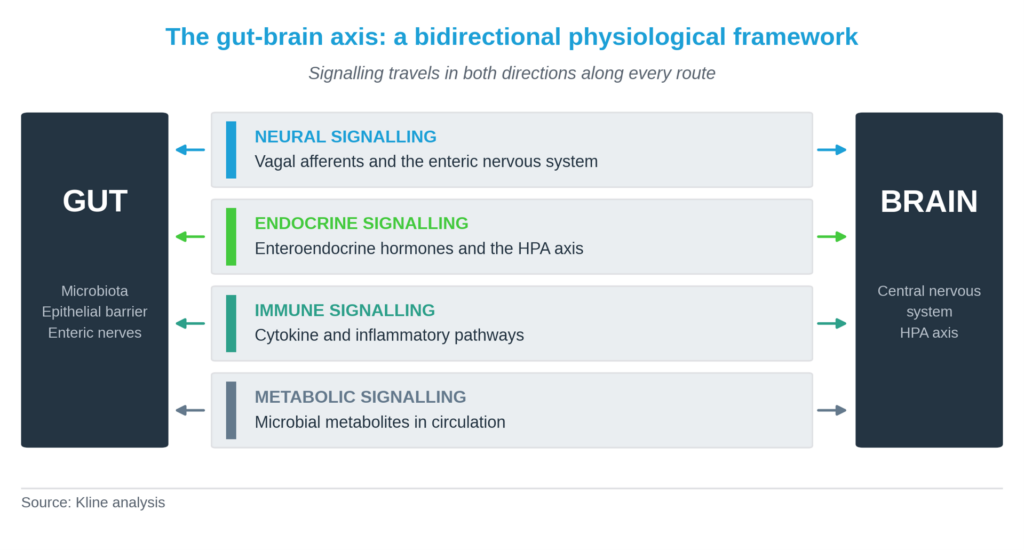
Illustrative physiological framework. The presence of these pathways does not establish efficacy or a permissible claim for a specific product, strain, dose, or format.
Those pathways are real, and the consensus definition makes the axis easier to defend as a research priority in an internal investment case. But the definition is also a measuring stick. The same vocabulary that organizes your substantiation argument can be used by someone else to test it, which is a net gain for companies with evidence and a net risk for companies without.
The aggregate human picture is more restrained than category marketing implies. The 2026 psychobiotics umbrella review, which appraised thirty systematic reviews and meta-analyses, found probiotics associated with improvement in depressive-symptom scores and markedly less consistent effects on anxiety. Roughly three-quarters of the reviews it appraised were rated moderate, low, or critically low in methodological quality. That is directional literature, not a definitive one.
Two consequences matter commercially rather than academically:
- The first is that the effects are strain-specific. Data generated on one organism does not transfer to another of the same species, however closely related, and a supplier presenting species-level evidence for a proprietary strain is presenting an argument rather than proof.
- The second is the gap most dossiers quietly contain: the evidence was generated on something other than the product being sold. A study run on a capsule does not automatically underwrite a gummy, a beverage, or a multi-ingredient formulation at a different dose, in a different matrix, with a different stability profile.
For ingredient suppliers, that distance is where differentiation sits. A dossier generated in the customer’s intended format reduces the manufacturer’s need to bridge evidence across dose, matrix, and delivery system: a real and specifiable benefit in a B2B conversation. Evidence generated by analogy leaves that bridging work, and the substantiation risk that comes with it, sitting with the customer.
2. Consumers prioritize gut health; fewer connect it to the brain.
Category commentary tends to assume shoppers have already absorbed the gut-brain story. Survey evidence published by IFIC in August 2026 suggests otherwise.
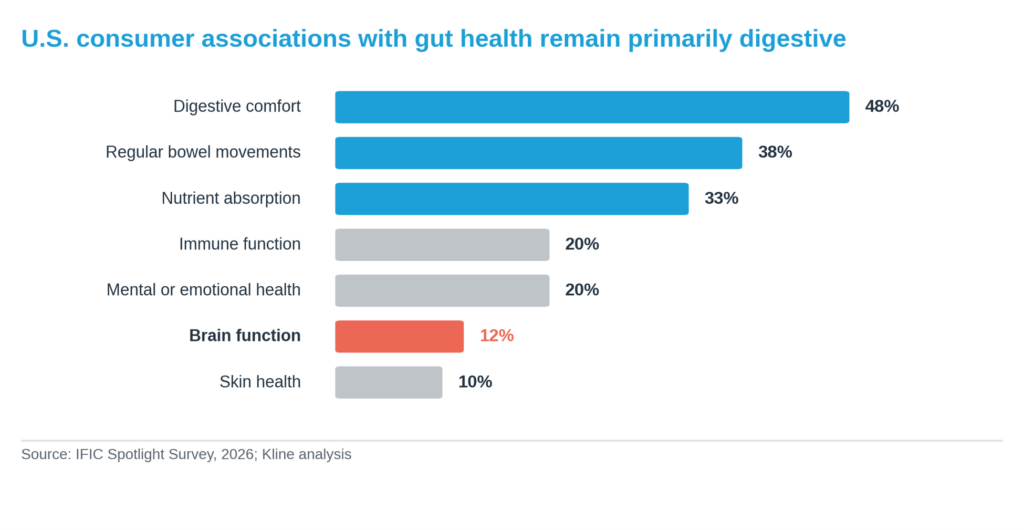
Online survey of 1,004 U.S. adults aged 18 and over, fielded 20-25 May 2026, weighted; published 4 August 2026. Figures are self-reported associations, not clinical outcomes or purchase intent.
Almost two-thirds of Americans treat gut health as a high or extremely high priority. Interest is clear. The more difficult question is how consumers define the benefit and whether they will act on a specific proposition. When asked what gut health affects, respondents named digestive comfort at 48%, regular bowel movements at 38%, and nutrient absorption at 33%. Brain function reached 12%.
Three further findings compound the difficulty. 84% rate their own gut health as good or better over the preceding month, so much of the addressable market does not believe it has a problem to solve. Behaviour is predominantly subtractive: 54% manage gut health by cutting foods out, while only 13% turn to a functional food or beverage. And trust sits with expertise rather than with brands: 74% trust healthcare professionals and 65% trust scientific studies, against 34% for food and beverage brands.
A direct gut-brain proposition may ask consumers to engage with a less familiar benefit association, while brands must communicate in an environment where healthcare professionals and scientific studies are more trusted sources of gut-health information.
There is a way around it, and it sits in the same survey. Asked what damages gut health, respondents put stress second at 37%, behind poor diet at 50%, but well ahead of ageing, hormonal change, and environmental exposure. Consumers already accept that the brain affects the gut. Considerably fewer accept the reverse. These are answers to two different questions, so the gap is a direction rather than a ratio, but the direction is consistent, and the likely explanation is experiential: a nervous stomach is felt, whereas a microbiota-mediated effect on mood has to be inferred.
The practical reading is that a proposition built around stress-related digestive comfort asks less of the consumer than one built around mood or cognition. It starts from an association many already report and addresses a symptom they can feel. That makes it a candidate entry point worth concept, claim, price, and competitive-positioning testing: not a conclusion, and not a substitute for the substantiation any specific claim still requires.
3. Permission does not travel
Claim substantiation is routinely treated as a scientific question with a single answer. It is closer to a jurisdictional question with several answers. What may be said differs by market, by product category, and by the exact wording used, and a claim permitted in one country does not port to another. A product license granted after pre-market review in one market is a credibility signal in a business-to-business conversation elsewhere; it is not permission elsewhere, and it should not circulate internally as though it were.
The operational consequence is sequencing rather than compliance. Define the claim route in your priority markets before you design the clinical programme, not after it, and then build the study around the shared minimum evidence requirement across those markets and the market-specific gaps, rather than over-designing for the strictest one. Regulatory positions change; verify each market with local counsel before committing to label or marketing language.
4. Four things must align
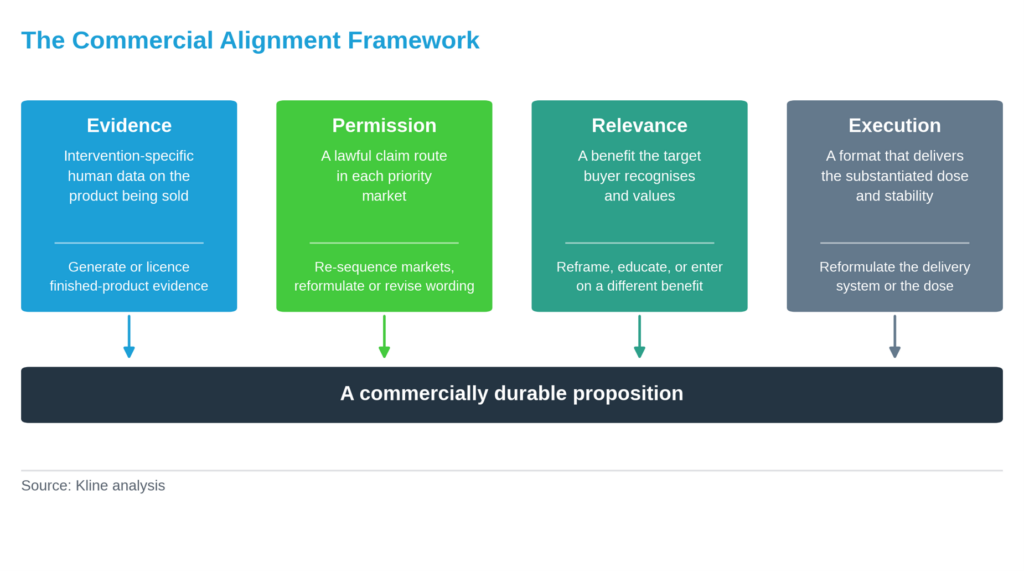
Illustrative Kline framework reflecting Kline’s analytical view, not an industry standard.
A gut-brain proposition is commercially durable when evidence, permission, relevance, and execution are held at the same time. Each dimension resolves to a question that can be answered before money is committed:
- Evidence: Does credible human evidence support this intervention, at this dose, in this format, for this population, and this outcome?
- Permission: Can the intended wording be used for this product category in each priority market?
- Relevance: Does the target buyer understand, value, and act on the benefit?
- Execution: Can the finished product deliver the substantiated dose, stability, and sensory experience at a viable price?
A gap in any one is not automatically fatal, but it names the specific work required before the launch. Evidence without relevance is the recurring pattern: a proposition that is scientifically interesting and legally supportable and means little to the intended buyer. Relevance without permission describes much of the European position. Permission without evidence or execution is the shortest-lived of the three — lawful language resting on borrowed ingredient-class data, or a format that cannot carry the substantiated dose through shelf life.
5. What to settle before the next innovation cycle
- Define the benefit and the priority markets first. Start from the exact proposition, target buyer, product category, and intended claim language, not from the ingredient.
- Assess evidence at product-equivalence levels. Establish whether the available data apply to your strain, dose, matrix, delivery format, and shelf-life profile, and pin the claim to the highest level the evidence genuinely supports.
- Test consumer translation, not scientific interest. Validate whether the benefit, digestive comfort under stress, say, or support for fullness, is understood, believed, differentiated, and worth paying for.
- Build regulatory review into innovation design. Do not assume a claim, a license, or a study outcome transfers across markets or product categories.
Simply talking about the gut-brain axis is no longer a differentiator. The vocabulary is public now, and it will be used to hold claims to account as readily as to support them. A credible proposition is not created by combining a plausible pathway with a popular consumer concern. It is created when intervention, evidence, claim wording, the target consumer, the product format, and the jurisdiction are aligned.
For ingredient suppliers, the commercial opportunity is to reduce the manufacturer’s path to alignment: bring product-relevant evidence, clear formulation guidance, and market-specific claim considerations rather than leaving the customer to assemble them.
How Kline can help
Kline’s Food & Nutrition practice tracks the ingredient, formulation, and claim dynamics, shaping gut health and the wider biotics category across major markets. We work with ingredient suppliers, manufacturers, and brand owners on where category value is forming, which ingredient and format positions are defensible, and how claim permissibility differs by market and product category.
Deep-dive B2B positioning is where we add the most: taking a portfolio, testing it against evidence, permission, consumer relevance and execution, and identifying which propositions merit investment and which do not.
To discuss how these dynamics apply to your portfolio, contact Kline’s Food & Nutrition practice.