
Dana Kreutzer
Project Manager, Beauty and Wellbeing
The physician-dispensed skin care market in the United States is evolving beyond a traditional retail model. Increasingly, professional skin care is becoming part of a broader aesthetic journey, connecting procedures, recovery, maintenance, and at-home care. Kline’s latest Physician Dispensed Skin Care: U.S. Perception and Satisfaction Survey suggests that the ability to strengthen these connections could be one of the industry’s most meaningful opportunities for future growth.
Patients are spending more, but the opportunity is shifting
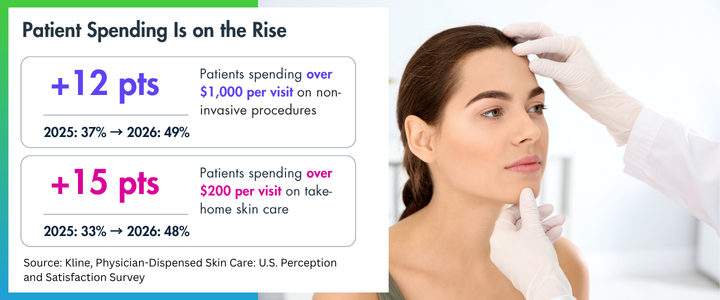
Patient economics remain encouraging. In 2026, 49% of patients spend more than $1,000 per visit on non-invasive aesthetic procedures, up from 37% in 2025. Meanwhile, the share of patients spending more than $200 per visit on take-home skin care rose from 33% to 48%.
Yet new-patient momentum has remained strong but moderated from historical levels. This points to an important opportunity: growth may increasingly come from capturing more value across the existing patient relationship, rather than relying primarily on new-patient acquisition.
Procedures are reshaping skin care needs
As investment in aesthetics increases, the role of skin care appears to be expanding with it. While traditional aging concerns remain important, 88% of dispensing physicians now consider skin barrier support very or extremely important when recommending professional skin care. The likely factor here is that the role of non-invasive aesthetic procedures is growing, leading to an increasing need for products that support skin recovery and maintenance around those treatments.
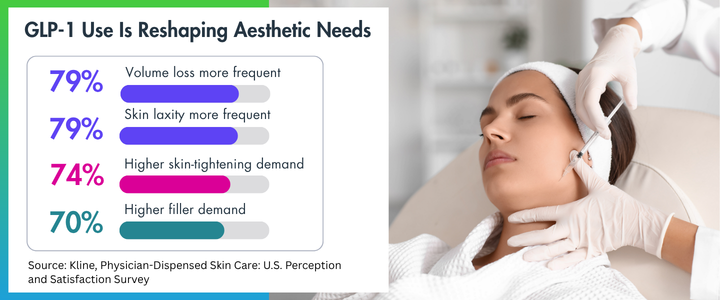
GLP-1 use is creating another emerging need state. Among patients using GLP-1 medications, 79% of respondents are seeing volume loss more frequently and 79% are seeing greater skin laxity or sagging. Practices are also reporting greater demand for skin-tightening treatments and dermal fillers.
For the industry, these shifts reinforce an increasingly integrated view of professional skin care, where products can play a role before, after, and between aesthetic treatments.
Recommendation is high, but consistency remains the opportunity
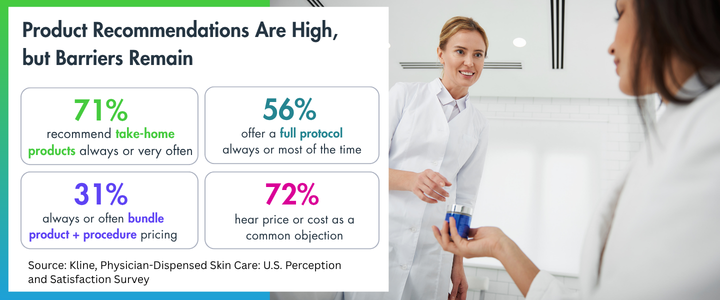
Most practices recognize that connection. 71% of physicians say that they recommend take-home products always or very often to enhance or maintain the results of non-invasive procedures. However, only 30% say that they always make that recommendation, leaving meaningful room to make product integration a more consistent part of the treatment journey.
Recommendation alone does not guarantee conversion. Nearly three-quarters of respondents cite the cost of a full regimen as a barrier, while 38% say that patients can become overwhelmed by too many recommended products or steps.
The next chapter of physician-dispensed skin care may therefore be less about recommending various products and more about creating simpler, credible, treatment-connected regimens that patients understand, value, and continue using.