
Kritika Jaiswal
Director, Energy
GCC countries are rapidly updating automotive and industrial regulations to align with global standards, focusing on quality, safety, and sustainability.
Harmonized standards (GSO 1785-1/2) and stricter emission rules (e.g., UAE’s EURO 6B by 2026) are driving demand for advanced lubricants and cleaner technologies. Ambitious electric vehicle (EV) targets across the region are reducing demand for traditional engine oils, prompting suppliers to innovate with synthetic, bio-based, and EV-specific products.
National strategies like Saudi Arabia’s Vision 2030 and UAE’s Operation 300bn are boosting local manufacturing and renewable energy initiatives, further shaping lubricant market trends. Supplier responses include expanding re-refined base oil capacity and launching eco-friendly formulations.
Overall, evolving regulations and sustainability goals are transforming the lubricants sector, driving innovation and supporting economic diversification in the GCC.
Standards and Regulations Adopted in the Middle East
The Middle East countries has been actively updating and implementing standards and regulations to align with global practices and address regional needs. These regulations span various sectors, including automotive and industrial focusing on quality, safety, and sustainability. This write-up explores the recent regulatory developments in the automotive and industrial sectors across the GCC, with a focus on Saudi Arabia, the United Arab Emirates (UAE), and Qatar.
For the automotive sector, the GCC Standardization Organization (GSO) has played a pivotal role in harmonizing automotive regulations across member countries to ensure harmonization ensures product quality, environmental protection, consumer safety, and trade facilitation across the region.
List of regulations:
1. General Standards: GSO 1785-1and GSO 1785-2 standards released in 2023 conform with API and ACEA classifications respectively with both focusing on standard set performance requirements for oils, covering aspects like wear protection, oxidation stability, and engine cleanliness.
2. Emission Standards: The countries are at various stages of adopting stricter emission standards. UAE requires new imported light and heavy vehicles to meet EURO 6B standards starting in January 2026 which becomes further stringent with all vehicles needing to comply by July 2027. Other GCC countries have different regulations, for example Bahrain at EURO 4 levels and Saudi Arabia at EURO 5 levels.
3. Sales of vehicles: In August 2025, Qatar’s Ministry of Commerce and Industry issued a decree that requires all new and used vehicles sold in the country to meet Gulf Standard Specifications. This ban applies to both physical and online sales platforms and prohibits the sale, display, or advertising of non-compliant vehicles to maintain high quality in the automotive market.
4. EV Initiatives and Targets: On going initiatives to increase adoption of EV’s and reduce emissions.
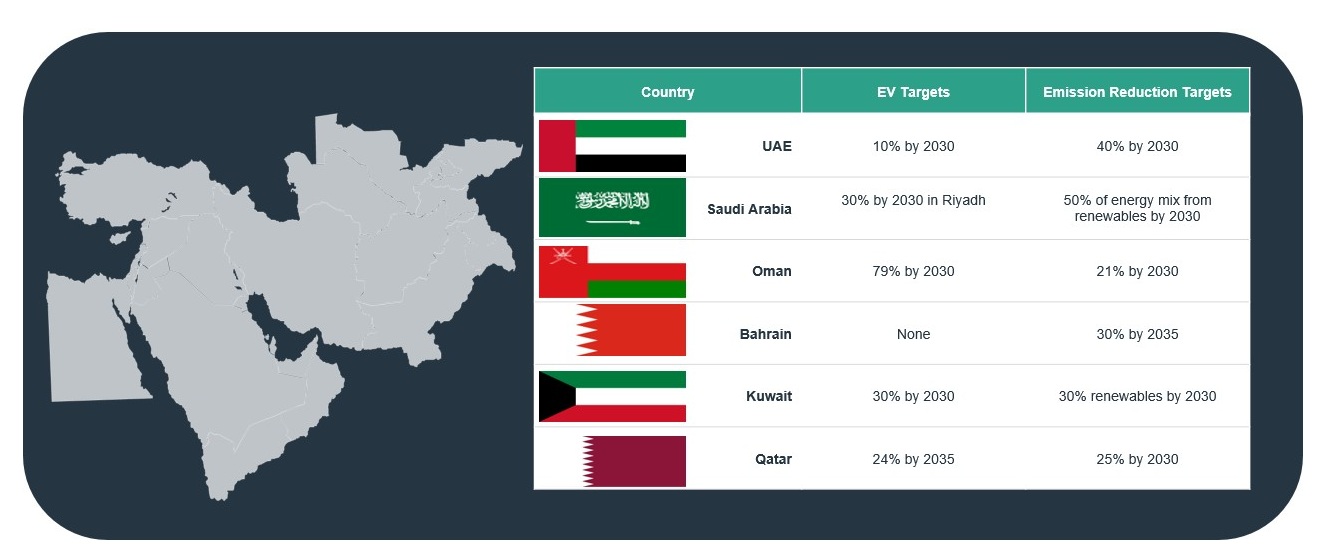
- Saudi Arabia is making significant strides towards electrifying its vehicle fleet, aiming for electric vehicles (EVs) to constitute 30% of the fleet in Riyadh by 2030. The country is heavily investing in domestic EV manufacturing, targeting an annual production of 500,000 cars by the end of the decade through initiatives like CEER and investments in Lucid Motors.
- United Arab Emirates (UAE) has aims for 10% of all cars to be green, including EVs and hybrids, by 2030, and 100% by 2050 and Dubai targeting 30% of annual new car sales to be green vehicles by 2030.
- Qatar plans for 10% of new vehicle sales to be EVs by 2030 and has already electrified its public bus fleet, backed by the installation of over 300 fast DC chargers by August 2025.
- Oman has with plans to transition 79% of its vehicle fleet to electric by 2035 and 22,000 EVs on the roads by 2030.
- Kuwait aims for a 30% EV penetration rate by 2030.
The Positive Impact
The alignment with international standards promotes market consistency in product quality across the GCC, facilitating trade and reducing barriers for suppliers. Stricter emission standards drive the adoption of cleaner technologies, reducing the automotive sector’s carbon footprint and aligning with global sustainability goals.
The implementation has prompted a market shift for engine oil towards higher-quality, advanced lubricants, necessitating changes in product formulation and market strategy high-performance, synthetic and semi-synthetic engine oils.
The demand for monograde HDMO has completely diminished across the region. This significant decline is attributed to several factors, including regulations like those from the Saudi Standards, Metrology, and Quality Organization (SASO) regarding minimum API service categories, the advent of more efficient vehicles, and the growth of large fleet operators.
This change aligns with the growing number of modern, fuel-efficient vehicles in the GCC, which require more advanced lubricants.
The Negative Impact
The increasing adoption of EVs and hybrids directly reduces the overall demand for engine oil used in internal combustion engines (ICE) as the need for frequent oil changes will decrease.
The GCC countries, traditionally dependent on oil as a major economic driver, are now seeking to diversify their economies and develop capabilities in other sectors besides oil. National strategies to promote manufacturing capabilities with policies like Saudi Arabia’s Vision 2030 and UAE’s Operation 300bn aims to nearly double the manufacturing sector’s contribution to GDP by 2031.
Manufacturing Sector
Development of renewables: In addition to EV targets, GCC countries are also focusing on emission reductions through renewable energy initiatives. The UAE aims to cut emissions by 40% by 2030, while Saudi Arabia plans for 50% of its energy mix to come from renewables by the same year. Oman and Qatar have set targets to reduce emissions by 21% and 25% by 2030, respectively, and Bahrain aims for a 30% reduction by 2035.
These emission reduction goals support the transition to cleaner technologies and further decrease reliance on fossil fuels, including traditional engine oils. As the region prioritizes environmental sustainability and the adoption of alternative energy sources, the engine oil market is likely to experience a negative impact due to the reduced demand for conventional products.

Hydrogen strategy: The UAE’s Hydrogen Strategy aims to produce 1.4 million tons of hydrogen annually by 2031 and 14.9 million tons by 2050, with plans to establish hydrogen oasis for production and utilization. Meanwhile, Saudi Arabia’s NEOM Green Hydrogen Company is developing the world’s largest hydrogen production facility,expected to start production by 2027, converting hydrogen into green ammonia for export.
Developing local manufacturing capabilities will provide growth opportunities for industrial lubricants and metal working fluids across automotive, metals and renewable manufacturing. The rise in adoption of wind turbines is expected to drive demand for synthetic gear oils.
Initiatives by Suppliers
Re-refined base oils: Increase in capacity of re-refined base oil production. For example: In Saudi Arabia, Yanbu plant owned by YUNITCO plans to increase capacity from 120 KT to 200 KT by end of 2025.
Eco-Friendly Formulations: Development of bio-based and biodegradable lubricants for sensitive ecosystems (marine, construction) ensures compliance with stricter environmental regulations and enhances corporate sustainability reputations. ADNOC launched an engine oil in the UAE that was formulated with 100% plant oil.
E-fluids for EVs: Local and international companies operating in the GCC, including Gulf Lubricants, Shell, and TotalEnergies, have launched specialized product lines for electric and hybrid vehicles.
The recent regulatory policies adopted by the GCC countries reflect a strong commitment to aligning with international standards and addressing regional needs.
In the automotive sector, harmonized standards and regulations ensure product quality, environmental protection, and consumer safety. In the industrial sector, ambitious renewable energy and hydrogen strategies demonstrate a commitment to sustainability and energy diversification. As these regulations continue to evolve, they will play a crucial role in shaping the future of the automotive and industrial sectors in the Middle East, driving innovation and sustainable growth.
This article originally appeared in the December 2025 edition of Lube Magazine.