
Carrie Mellage
Vice President, Beauty and Wellbeing

Dr. Elizabeth Thundow
Vice President, Food and Nutrition
Every year, trend predictions give new names to shifts already taking shape in the market. One of the more interesting entries in Whole Foods Market’s ‘Top Food and Beverage Trend Predictions for 2027’ is “Beautrition”, its term for the growing intersection between beauty and nutrition.
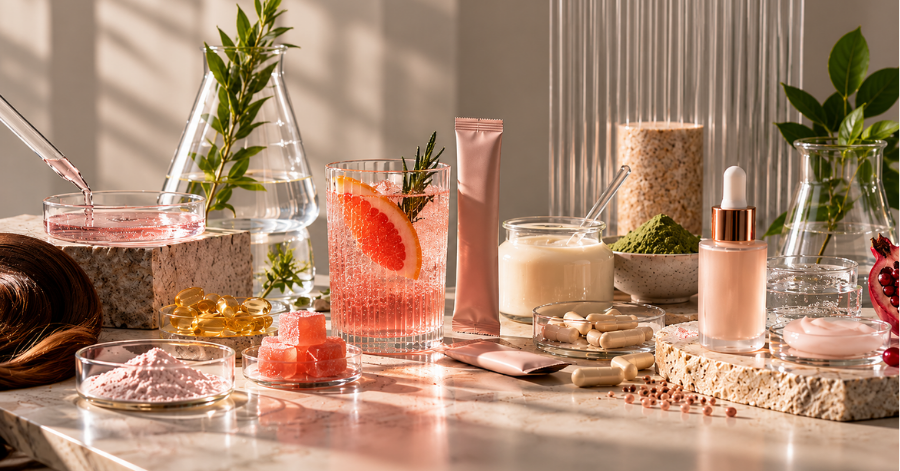
The examples range from collagen teas and gummies to olive oil shots and sparkling collagen water, reflecting growing interest in ingredients associated with skin health being delivered through products that blur conventional distinctions between food, drink, supplements and beauty.
It is tempting to see this simply as the latest evolution of “beauty from within”. But zoom out, and something more significant is happening.
Supplements are moving beyond capsules and powders into formats that increasingly resemble food and confectionery. Biotics are showing up in mainstream beverages. GLP-1 is changing formulation requirements around protein, fiber, nutrient density, hydration and sensory performance. Beauty companies are expanding into ingestible wellness. And within beauty itself, skincare science and ingredients are moving into adjacent areas such as hair and scalp care.
Look at each development through the lens of a traditional market category and they can appear to be separate trends.
Look at them from the ingredient out, and the connections become much clearer.
The same questions begin to surface across applications. Which ingredients can deliver the required functionality? At what dose? In which format? What does that mean for taste, texture, stability and sensory performance? What evidence is needed to support the proposition? And can it work commercially at scale?
Those questions matter because convergence is not simply changing what appears on the shelf. It is changing the formulation brief behind the product, and increasingly, the routines and experiences being built around it.
Supplements Are Moving Beyond The Supplements Aisle
Capsules, tablets and powders remain established delivery formats, but supplement propositions are broadening.
In our recent article, Uncapped Potential: What Happens When Supplements Move Beyond Capsules?, we explored formats ranging from creatine gummies and fizzing sachets to collagen jelly sticks, oral sprays and personalized nutrient gummies.
But changing the format changes much more than the appearance of the finished product.
A jelly stick has to achieve the right gel structure and flavor while delivering its intended active dose. A gummy brings trade-offs between ingredient loading, serving size and the eating experience. Fizzing powders create another set of formulation considerations. Processing compatibility, stability and packaging performance all have to be considered alongside consumer appeal.
That puts greater emphasis on the wider ingredient system. Flavors, sweeteners, texturants and other supporting ingredients can be just as important to making the finished proposition work as the functional ingredient at its center.
As supplements become more food-like, some of the formulation challenges traditionally associated with food and beverage become increasingly relevant to the supplement industry.
At the same time, functionality is travelling in the other direction.
Functional Ingredients Are Moving Into Everyday Food and Beverage
Prebiotic soda offers a useful illustration.
In our work on the evolving biotics market, we have been tracking how microbiome-focused ingredients are moving beyond supplements and specialized nutrition into everyday food and beverage occasions. Prebiotic soda is one particularly visible example, with brands such as Olipop and Poppi joined by activity from Coca-Cola.
But the interesting innovation question is not simply whether a beverage contains a prebiotic.
Ingredient selection, dosage, scientific substantiation, sweetening systems and sensory performance all play into the finished proposition. As more products enter the market, successfully balancing functionality with taste, affordability and scalability becomes an increasingly important part of the competitive equation.
Putting a functional ingredient into a familiar format is one thing. Building an effective and commercially viable product around that functionality is another.
And elsewhere in food and nutrition, other forces are making the formulation challenge even more complex.
GLP-1 Is Changing What Food Needs To Deliver
Much of the conversation around GLP-1 has focused on changing consumption patterns. From an ingredient perspective, however, there is another question: what happens to the formulation brief when consumers eat differently?
In our recent work on GLP-1 and ingredient manufacturers, we explored how lower food intake can increase the nutritional and sensory demands placed on what is consumed.
We see this creating a shift towards “compact nourishment”, with greater emphasis on protein, fiber, micronutrients and hydration within smaller eating occasions. But packing more functionality into less food creates its own challenges. Higher active or nutrient loads can introduce bitterness, astringency, viscosity, texture and shelf-life issues.
This changes the opportunity for ingredient companies.
Protein may be important, but protein alone is not necessarily a complete solution. The formulation can also require hydrocolloids, starches, emulsification, flavor masking and mineral compatibility to deliver the intended nutritional and sensory experience. Sugar reduction creates another systems challenge because sugar contributes to bulk, browning, preservation, freezing behavior and mouthfeel as well as sweetness.
Increasingly, therefore, the opportunity is not simply about the performance of an individual ingredient. It is about ingredient systems and the ability to solve the complete formulation brief.
And this movement towards a more integrated understanding of functionality is not limited to food and nutrition.
Beauty Is Moving Inward, While Beauty Science Moves Outward
The relationship between beauty, health and nutrition is becoming increasingly visible.
Shiseido, for example, launched SHISEIDO BEAUTY WELLNESS as its first step into the wellness business field, creating an inner-beauty business spanning beauty and wellness. Its approach included joint research and development with Tsumura and food company Kagome, while its inner-beauty offering includes beauty drinks and supplements.
That makes beauty-from-within more than a conceptual trend. Established beauty businesses are already exploring propositions that extend beyond traditional topical beauty.
But the convergence is increasingly visible not only in individual products, but also in the routines being built around a shared outcome.
A skin, hair or healthy-ageing proposition can extend beyond a single format or category. Topical products, ingestible products and other beauty and wellness solutions can potentially sit within a broader regimen addressing the same need.
That creates an opportunity that is bigger than simply entering an adjacent category. The question becomes how different products and formats work together around a shared need, and how that proposition fits into the way consumers already understand and manage their beauty and wellness routines.
Beauty also brings something distinctive to ingestible wellness: an established understanding of regimen, sensoriality and aspiration.
As functionality enters increasingly consumer-friendly formats, the experience surrounding the ingredient becomes important too. Flavor, texture, packaging, convenience and the language used to explain a regimen can help translate a technical or functional proposition into something more accessible and desirable.
The consumer experience becomes part of the value proposition, not simply the vehicle for delivering an active ingredient.
But this expansion brings another challenge.
As topical products, supplements and functional foods increasingly address overlapping outcomes, the landscape can become harder to navigate. Companies need to be clear about what a product is intended to do, the evidence supporting it, and how it fits alongside other elements of a broader regimen.
Adding another product is relatively easy. Building a proposition that is clear, credible and genuinely complementary is much harder.
And the crossover works in another direction too.
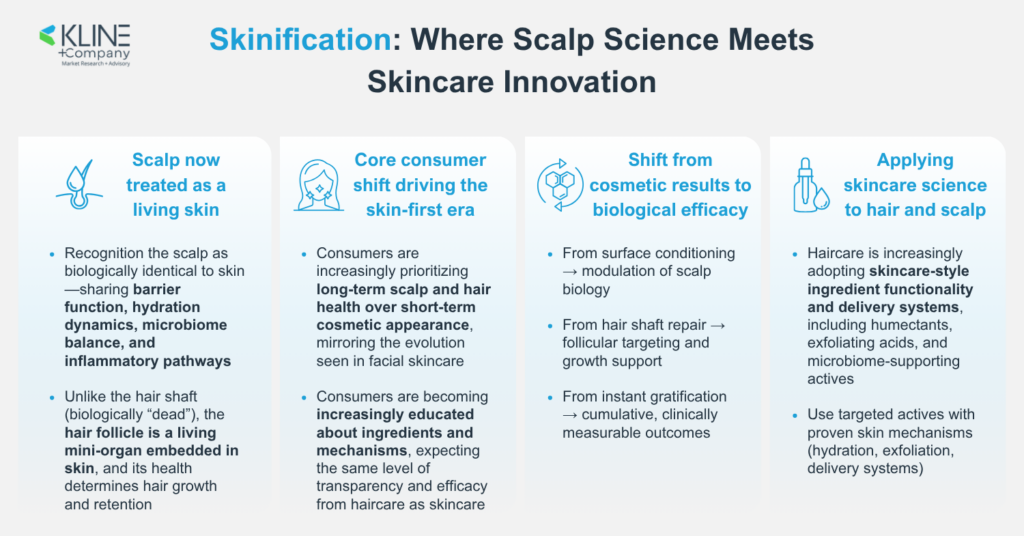
Within hair care, skincare science and ingredient thinking are increasingly influencing how hair and scalp needs are addressed.
At Suppliers’ Day, our Vice President and Global Practice Leader for Chemicals & Materials, Desai, Sunanda, explored how skinification is reshaping hair care alongside hair wellness, longevity, restoration and hair growth. Our work highlights opportunities for personal-care ingredient suppliers to bring skincare science into scalp wellness, including ingredient families such as ceramides, hydroxy acids, natural oils, proteins and peptides, and B vitamins.
Again, the interesting point is not simply that one beauty category is borrowing ideas from another.
It shows what happens when established ingredient science, functionality and efficacy expectations migrate into a new application.
The formulation environment changes. Claims and competitive dynamics change. And importantly, the way the benefit is translated into a proposition that people can understand and incorporate into their routines changes too.
But the underlying ingredient capabilities can create connections between markets that look quite separate when viewed only through conventional category definitions.
Is Healthspan Becoming A Common Language?
If ingredients provide one way of seeing the connections between categories, outcomes provide another.
Healthspan is a particularly interesting example.
In nutrition, we’re seeing the conversation move beyond a broad healthy-ageing narrative towards a more practical healthspan agenda: which ingredients can credibly support particular outcomes, which formats are gaining relevance, and which opportunities are commercially viable?
Our Food and Nutrition work has looked at healthspan as a portfolio-level issue, with ingredient-led innovation spanning nutrition and the increasingly active territory between medical nutrition and functional food and beverages.
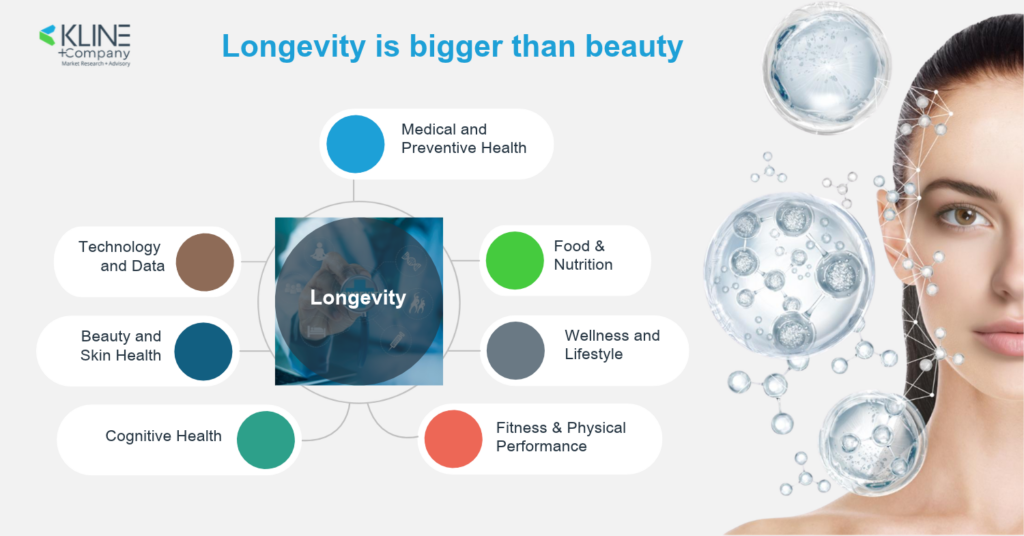
Beauty approaches longevity from a different starting point, but the direction is strikingly complementary.
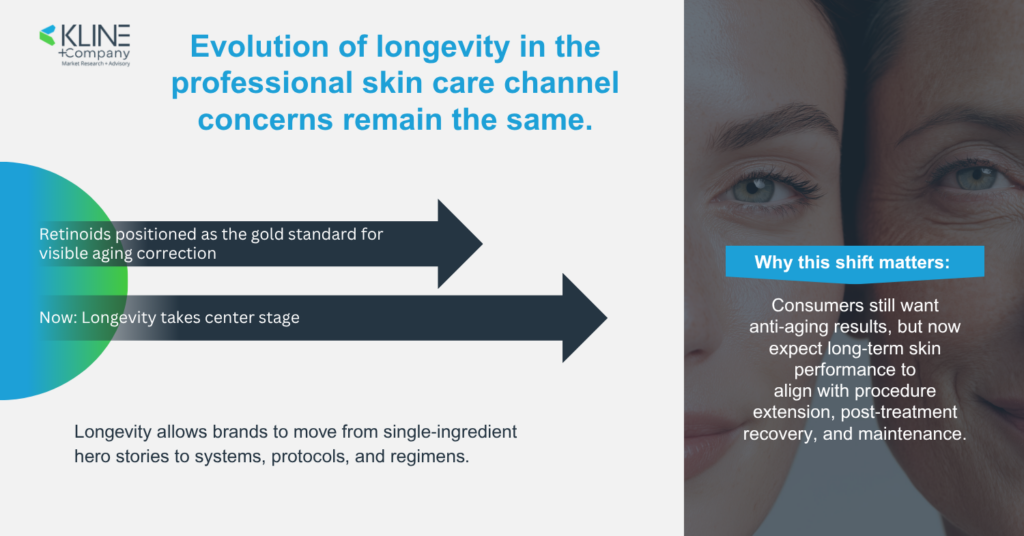
Our Beauty and Wellbeing research reframes the opportunity around “skin healthspan” rather than age correction, with greater emphasis on barrier resilience, inflammation control, regeneration and recovery. It also identifies an opportunity to extend longevity thinking beyond facial skincare into hair, scalp and body.
That creates an important meeting point between the two sides of convergence.
Ingredients and technologies are moving across applications, while propositions are increasingly being organized around broader outcomes such as healthspan rather than a single product category.
Nutrition and beauty are not becoming the same market. And a functional food, supplement or topical beauty product does not play an interchangeable role.
But they can increasingly address different dimensions of the same broader objective: supporting health, resilience and performance for longer.
This is also where the idea of a connected regimen becomes especially interesting. Rather than thinking only about a standalone skincare product, supplement or functional food, the opportunity is to understand how different interventions can credibly sit around the same need and what role each should play.
That requires more than spotting a consumer trend. It requires understanding the underlying ingredients, science, applications and evidence, alongside the experience that ultimately brings the proposition together.
Start With The Ingredient, Then Follow Where It Goes
Viewed individually, these developments can sit comfortably in separate market categories.
Prebiotic soda belongs in beverages.
Collagen jelly sticks sit within supplements or beauty nutrition.
Skinification belongs in hair care.
GLP-1 sits at the intersection of pharmaceuticals, health and nutrition.
Longevity stretches across health, nutrition, wellness and beauty.
But start with the ingredients, functionality and formulation requirements underneath them, and those boundaries become much more permeable.
Proteins, fibers, biotics, peptides, vitamins and botanical actives can have relevance across multiple applications. Flavors, sweeteners, texture systems and other formulation technologies become important as higher levels of functionality are translated into consumer-friendly formats. Our research across these areas shows how the formulation challenge changes as ingredients move between applications.
This opens up a different set of questions for companies trying to determine where to focus next.
Which ingredient technologies have credible relevance beyond their established applications?
Where is functionality moving from one market into another?
What new formulation requirements emerge when it does?
Which capabilities can genuinely transfer into adjacent markets?
And where does that create a commercially meaningful growth opportunity rather than simply an interesting product concept?
For ingredient suppliers, these questions can inform where to build application and technical capabilities.
For manufacturers, they can reveal where the formulation brief is becoming more demanding.
For brands, they can broaden the view of where future innovation, partnerships and competition could come from.
And as more needs are addressed across multiple products, formats and categories, there is another challenge: making that complexity simple for the consumer.
The strongest proposition may not be the one that puts the greatest number of products around an outcome. It may be the one that connects ingredient efficacy, formulation, experience and evidence in a way that consumers can readily understand and trust.
The Next Opportunity May Not Fit Neatly Into Today's Categories
Traditional categories still matter. They shape regulatory environments, supply chains, competitive landscapes and routes to market.
But they do not necessarily tell the whole story of where innovation begins.
Whole Foods Market’s “Beautrition” prediction captures one highly visible expression of the change.
Look underneath it and a broader picture emerges.
Supplements are taking on food-like formats. Functional ingredients are moving into everyday eating and drinking occasions. GLP-1 is changing nutritional and formulation requirements. Beauty is expanding its relationship with ingestible wellness. Skincare science is moving into hair and scalp. And longevity is creating new conversations about healthspan across nutrition and beauty.
These are different developments on the surface. At the ingredient and formulation level, they are much more connected.
For companies looking for the next source of growth, that distinction matters.
The opportunity may not always be another application within an existing category. It may begin with understanding where an ingredient, technology or capability already established in one market can solve an emerging need somewhere else, and then translating that opportunity into a proposition that is technically credible, commercially viable and clear to the people it is ultimately designed for.
Sometimes, the clearest view of where markets are heading comes from starting further upstream.