
Dr Antonella Liselle
Project Manager, Food and Nutrition
Why “compact nourishment” is shifting value upstream from commodity volume to nutrient density, formulation systems, and technical service.
THE CORE IDEA
GLP-1 does not simply reduce food volume. It raises the performance expected from every gram consumed. For upstream ingredient manufacturers, the strategic opportunity is to help customers deliver more nutrition, better sensory quality, and greater convenience in smaller portions.
GLP-1 receptor agonists are changing the economics of food consumption. Users typically eat smaller portions and snack less often, while seeking more protein, fiber, and functional benefits. In a 2024 AMC Global/OpinionRoute study cited by Nutritional Outlook, 95% of users reported eating smaller portions, 78% wanted smaller packs, 82% wanted foods with functional benefits, and 60% sought more protein-rich options. The implication is not simply “less food.” It is a transition toward fewer eating occasions carrying a higher nutritional and sensory burden.
For ingredient manufacturers at the top of the value chain, this changes the growth equation. Commodity suppliers remain exposed to lower tonnage in calorie-dense categories, but specialty suppliers can capture more value per serving through proteins, fibers, biotics, micronutrient premixes, texture systems, sweetener blends, flavor modulation, and application support. The winners will not necessarily be companies with one fashionable ingredient. They will be those that can solve the complete formulation brief.
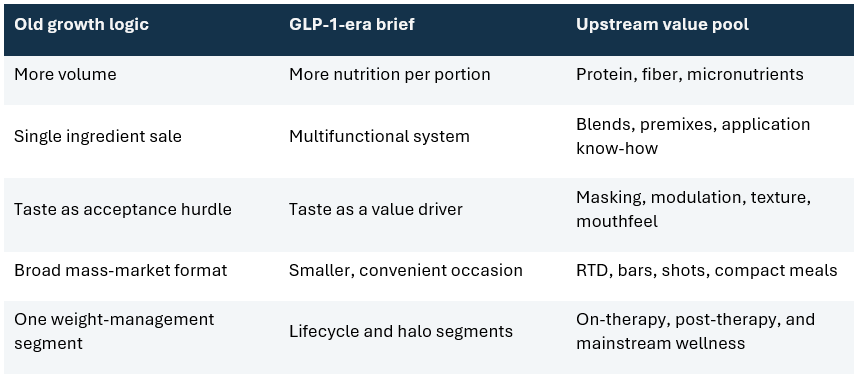
The shift in one view
1. From calorie displacement to “compact nourishment”
The first-order effect of GLP-1 adoption is lower intake. The more important second-order effect is a tougher formulation brief. When appetite falls, consumers have fewer opportunities to obtain protein, fiber, vitamins, minerals, and fluids. This creates demand for products that are portion-controlled and nutrient-dense without feeling clinical or punitive.
This is where the upstream opportunity emerges. Ingredient inclusion may rise even when finished product volume falls. A smaller meal can require a higher concentration of proteins and fibers, more robust vitamin and mineral premixes, and stronger stabilization. At the same time, the formulation must remain enjoyable. High active loads can create bitterness, astringency, chalkiness, viscosity, and shelf-life challenges. These trade-offs elevate the value of application laboratories, sensory science, and co-development support.
2. Protein remains the center of gravity, but systems will win
Protein is the clearest beneficiary because lean-mass preservation is a central concern during rapid weight loss. Nutritional Outlook reported analyses suggesting that lean body mass could represent up to 39% of semaglutide-associated weight loss, compared with 20% to 30% under lifestyle interventions. This strengthens the case for dairy and plant proteins across beverages, bars, yoghurts, compact meals, and specialized nutrition.
However, protein alone is not a differentiated strategy. As more suppliers pursue the same growth pool, value will migrate to systems that achieve high protein density while preserving texture, dispersibility, flavor, and digestive tolerance. Ingredient manufacturers should therefore connect protein platforms with hydrocolloids, starches, emulsification, flavor masking, and mineral compatibility rather than selling grams of protein alone.
3. Fiber, biotics, and digestive comfort move into the core brief
Fiber is becoming the second pillar of GLP-1-aligned formulation. Soluble fibers, prebiotics, and resistant starches can support fiber enrichment and contribute to texture or bulking, but tolerance matters. Products aimed at consumers with reduced appetite must balance meaningful inclusion with palatability and digestive comfort.
This expands the opportunity beyond a narrow “GLP-1 companion” claim. The same ingredient systems can serve mainstream consumers interested in satiety, metabolic wellbeing, microbiome health, and healthy ageing. For manufacturers of biotics and soluble fibers, the addressable opportunity is therefore broader than active medication users. The strongest commercial platforms will translate a therapy-linked need into an inclusive benefit architecture relevant to current users, former users, and non-users pursuing similar outcomes.
4. Sugar reduction becomes a systems challenge, not a single-ingredient substitution
Lower appetite and reduced demand for some sweet, indulgent categories reinforce existing sugar-reduction pressure. Yet removing sugar remains technically complex because sugar contributes to bulk, browning, preservation, freezing behavior, and mouthfeel, as well as sweetness. Smaller portions and higher nutrient loads make those functions even more visible.
The upstream opportunity is therefore not simply to sell a high-intensity sweetener or a rare sugar. It is to provide a complete sweetness and texture system, combining sweeteners, bulking agents, fibers, starches, flavors, and masking technologies. This favors suppliers that can optimize cost-in-use and sensory performance across the full matrix. It also raises the strategic value of technical service because customers need application-specific solutions rather than ingredient substitution ratios.
5. Taste, texture, and hydration are moving from support functions to growth platforms
As portion size declines, every bite matters more. A formulation defect that was tolerable in a larger eating occasion can become decisive in a compact product. This makes taste modulation, bitterness masking, mouthfeel restoration, moisture management, and controlled release central to commercial success.
Hydration also merits greater attention. Reduced intake and digestive side effects can make convenient fluid delivery more relevant, supporting opportunities for electrolytes, soluble fibers, clear proteins, beverage systems, and nutrient premixes. For upstream suppliers, this is an attractive adjacency because it connects food, beverage, sports nutrition and specialized nutrition capabilities.
6. The competitive model is shifting from ingredient portfolio to solution platform
Internal Kline work across sweeteners and biotics points to a wider industry transition: ingredient manufacturers are seeking greater influence over downstream innovation through scientific validation, formulation expertise, and integrated solutions. In the GLP-1 context, this means competing around need states such as muscle preservation, digestive comfort, satiety, hydration, and nutrient density rather than around one ingredient category.
This creates a practical portfolio question. Can a supplier combine proteins, fibers, sweetness, texture, and taste into a coherent customer proposition? If not, partnerships, licensing, or targeted acquisitions may be more effective than building every capability internally. The commercial advantage lies in reducing the customer’s formulation burden and time to market.
A strategic agenda for ingredient manufacturers
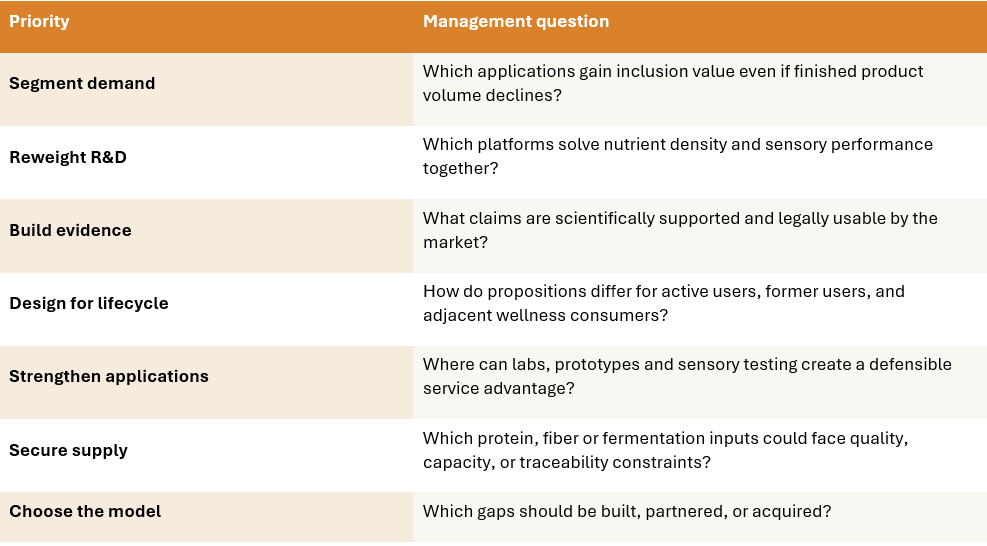
The strategic conclusion
GLP-1 should not be treated as a narrow product trend or a single ingredient opportunity. It is a reallocation of value across the food system. Lower consumption volume can pressure commodity ingredients, while higher performance per portion increases demand for functional inputs, formulation systems, and technical service.
For upstream ingredient manufacturers, the most resilient response is to move from selling inputs to solving nutritional and sensory outcomes. That means connecting portfolio choices, evidence, application science, and go-to-market strategy around the needs created by smaller appetites. The commercial prize is not only the active GLP-1 user. It is the wider shift toward compact, nutrient-dense, and functionally credible food.
What does GLP-1 mean for your business?
As GLP-1 reshapes consumer behavior, the impact will differ across ingredient categories, applications, and markets. Kline can help you understand where demand is shifting, where new opportunities may emerge, and what it could mean for your portfolio and growth strategy.
Talk to Kline to explore the impact of GLP-1 on your business.