
Following the breakdown of its high-profile merger talks with Estée Lauder, Puig is quickly turning the page and opening a bold new chapter. The company’s agreement to acquire the remaining 50% stake in ISDIN for $1.39 billion marks a major strategic pivot for the beauty giant.
Coming just weeks after Wella’s IPO filling, this transaction thrusts professional beauty back into the spotlight, underscoring Puig’s renewed focus on science-driven, professionally endorsed brands. While Puig and ISDIN operate in different market segments, this deal signals a clear path forward for the company: prioritizing categories where professional expertise, consumer trust, and strong brand equity drive durable, long-term growth.
According to the announcement, Puig views expanding its presence in dermocosmetics as a key priority, with full ownership providing greater ability to invest behind ISDIN’s science, innovation, and global growth ambitions. Moreover, beyond what the deal means for Puig and ISDIN, it also offers a broader lens on the professional skin care industry:
- Professional Skin Care Is Increasingly Viewed as a Strategic Beauty Category
Kline’s research shows that professional skin care continues to demonstrate resilience even as consumer spending becomes more selective. Growth is increasingly concentrated among brands that successfully connect clinical efficacy, provider education, and consumer demand creation. This combination becomes increasingly valuable as consumers scrutinize claims more closely and look for products that can demonstrate tangible benefits.
For large beauty companies, this creates an attractive proposition: brands with strong dermatological credentials can participate in premiumization trends while benefiting from consumers’ growing focus on prevention, skin health, and treatment outcomes.
- ISDIN Represents a Distinctive Model Within Professional Skin Care
While many professional brands built their businesses through aesthetics, physician dispensing, or medical spas, ISDIN has carved out a differentiated position around dermatology-led skin health, particularly in photoprotection and physician-recommended skin care.
Kline’s Physician Dispensed Skin Care: Brand Perception and Satisfaction Survey highlights that ISDIN is particularly recognized for its strong clinical evidence and patented formulations. Among dispensing physicians, the brand consistently performs well on attributes related to scientific credibility and efficacy, two factors that remain among the most important drivers of professional brand adoption.
Strongest Drivers of ISDIN Brand Success
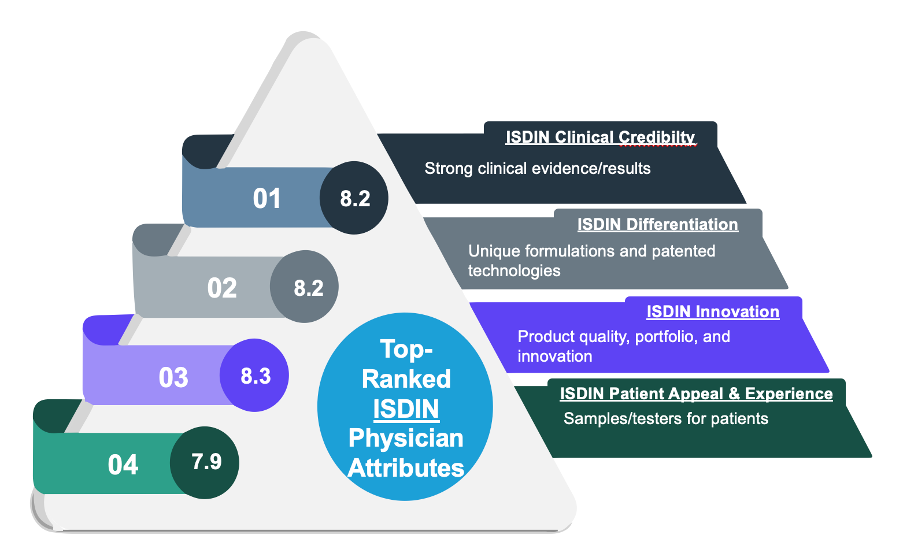
ISDIN’s focus on science-backed sun care and dermatologist-recommended skin health solutions positions the company squarely within these high-growth areas.
- Boundaries Between Professional and Retail Channels Continue to Blur
Another reason why this acquisition is notable is that ISDIN has been one of the brands helping redefine what professional skin care looks like in an increasingly hybrid market.
Kline has observed a broader shift away from strict channel exclusivity. Professional skin care brands are increasingly expanding into controlled retail, specialty beauty, and digital commerce while maintaining relationships with healthcare professionals.ISDIN’s expansion into Sephora and broader retail distribution reflects this trend.
Meanwhile, consumers are demonstrating increasingly fluid purchasing behaviors. According to Kline’s Aesthetic Skin Care Consumer Insights, many discover professional skin care through physicians or medical spas but ultimately repurchase through digital channels. Approximately 60% of recent professional skin care purchases now occur outside of physician offices, med spas, or brands’ online shops.
For Puig, ISDIN provides exposure to a brand that operates effectively across both professional and consumer touchpoints, making it particularly well positioned to benefit from the convergence of dermatology, beauty retail, and e-commerce. Furthermore, it suggests that the company sees significant runway ahead, not for only one brand but for the dermocosmetics category as a whole.
More broadly, as professional skin care becomes more integrated into wellness, longevity, prevention, and skin health conversations, brands with strong dermatological heritage are likely to attract increasing interest from strategic acquirers and investors.
How Can Kline Help
 CN
CN
 EN
CN
EN
CN
 JP
CN
EN
CN
JP
JP
CN
EN
CN
JP