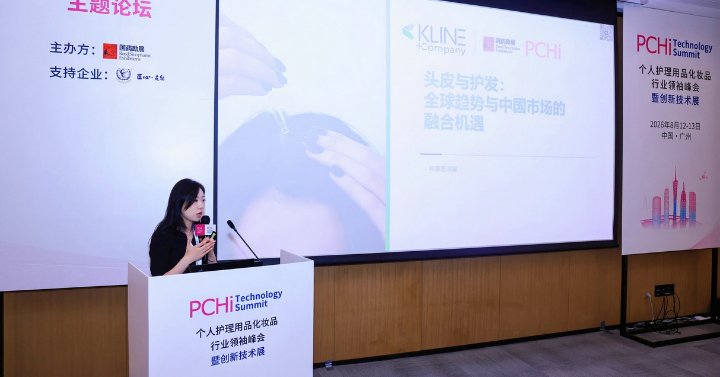
At the PCHi Technology Summit in Guangzhou, Carol Du, Consultant, Beauty & Wellbeing, China, at Kline + Company, presented select findings from Kline’s latest research on the professional hair care industry. The presentation highlighted the growing importance of scalp health within the professional hair care markets globally and in China. Many of the themes discussed during the session resurfaced throughout the exhibition, reinforcing how ingredient innovation, efficacy-driven formulations, and scalp-focused solutions continue to shape the beauty landscape.
1. “Skinification” Expands Across All Categories With Hair and Scalp Leading the Charge
The most prominent theme across the entire show floor was the continued migration of skin care-grade actives into adjacent categories. Ingredients traditionally associated with facial serums, such as peptides, ceramides, ferments, and ectoin, are now being specified for scalp serums, body care, and even color cosmetics. This represents a fundamental realignment of ingredient development pipelines, with suppliers increasingly designing multifunctional actives that can perform across formats and use cases.
The trend was particularly evident in scalp care, a category highlighted by Kline during its presentation at PCHi. According to Kline’s Professional Scalp Care Product: Global Market Snapshots, the global professional scalp care market reached approximately US$ 1.1 billion in 2025 and grew by roughly 10% compared to the previous year, based on 11 major markets analyzed in the study. The United States and Mainland China together account for more than 40% of global scalp care sales, underscoring the scale of the opportunity behind scalp-focused innovation.
2. PDRN: The Hype Is Real, but Commercial Scale Remains Limited
Polydeoxyribonucleotide (PDRN) was one of the most talked-about ingredients at PCHi 2026, with multiple high-profile launches. One of the most notable was from Bloomage Biotechnology, which has built approximately 2 tons of pharmaceutical-grade capacity slated for Q3 2026, and has already begun supplying cosmetic-grade PDRN to global prestige brands such as L’Oréal as well as major Asian skin care companies such as Proya Cosmetics, Chicmax, Winona (Yunnan Botanee), and Erno Laszlo.
However, from a raw material market perspective, the gap between industry buzz and commercial reality is significant. PDRN is currently a high-cost, high-complexity ingredient with regulatory pathways still being defined across different regions. Its adoption remains concentrated among premium brands seeking innovation storytelling rather than mass-market formulations. For ingredient suppliers, the near-term opportunity lies not in volume but in establishing technical leadership and clinical credibility before the market matures.
3. Microbiome and Barrier Health Move From Differentiator to Expectation
The microbiome narrative has transitioned from a trend to a baseline expectation. Across both skin care and hair care, suppliers are presenting solutions that balance microbial ecosystems through not only prebiotics/postbiotics but also targeted actives that modulate specific strains (e.g., Cutibacterium acnes, Staphylococcus epidermidis, and Malassezia). The emphasis has shifted from “good vs. bad” bacteria to quantitative balance and barrier integrity—physical, chemical, and microbial. This convergence means that raw material suppliers can now develop single ingredients that address both skin and scalp barrier functions, increasing commercial viability.
This evolution closely mirrors Kline’s findings, where microbiome balance is increasingly viewed as a foundational pillar of scalp health. Rather than focusing solely on visible concerns such as dandruff, brands are shifting toward longer-term strategies centered on ecosystem balance, inflammation management, and barrier support.
Consumer behavior supports this trend. Kline’s social listening analysis found that anti-inflammatory, soothing, and oil-control claims are among the fastest-growing scalp-related discussion topics globally, demonstrating a shift from symptom treatment toward preventative scalp health management.
4. Regulatory Agility Becomes a Competitive Advantage
With China’s cosmetic ingredient dossier requirements and the evolving definition of “new cosmetic ingredients,” regulatory strategy is now as important as formulation science. Suppliers that can efficiently navigate the National Medical Products Administration (NMPA) approval process and can provide full safety and efficacy documentation are commanding premium partnerships with domestic brands. This was a consistent theme in conversations across both skin and hair categories, with smaller innovators struggling to meet documentation thresholds, while larger players treat regulatory capability as a core competency.
5. Sustainability Shifts From Marketing to Procurement Reality
Sustainability is no longer just a brand storytelling tool. At the procurement level, major buyers are asking for verifiable environmental metrics such as carbon footprints, renewable sourcing, and biodegradability data. Several suppliers showcased upcycled ingredients and fermentation-derived actives as cost-competitive alternatives to traditional extraction methods. In the raw material business, the conversation has pivoted from “why sustainability” to “how to prove it.”
One of the strongest takeaways from this year’s PCHi was the industry’s growing focus on scalp health as a holistic ecosystem rather than a standalone product category. From microbiome-centered formulations and skin care-inspired actives to scalp diagnostics, professional treatments, and emerging head spa concepts, the future of scalp care is increasingly being built around integrated consumer experiences.