

Shilpi Mehrotra
Senior Project Manager, Chemicals and Materials
Sustainability in personal care is no longer a differentiator brands can win on with a claim. It is becoming the baseline, and the bar is now proof.
For much of the last decade, “sustainable” personal care was communicated on the front of the pack: a leaf motif, a recyclable symbol, a “clean” or “green” promise. That era is closing. Consumers, retailers, and regulators have all grown more sophisticated at the same time, and the question has shifted from “Is it sustainable?” to “Can you prove it?”
For ingredient suppliers and brand owners alike, that shift changes where value is created, and where risk now sits.
Sustainability Has Become a Purchase Driver, Not a Nice-To-Have
Sustainability considerations increasingly sit alongside efficacy and price in the personal care purchase decision. Shoppers pay attention to sourcing, carbon footprint, and packaging, but their trust is conditional. Vague messaging no longer moves product; specific, substantiated benefits do.
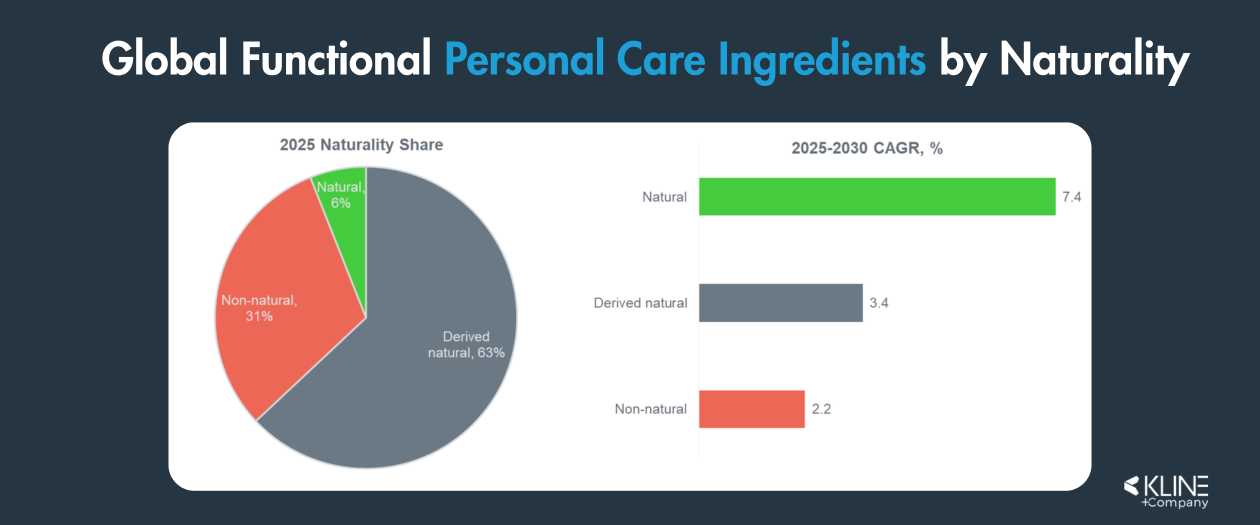
The shift is measurable. Kline data shows that natural and naturally derived ingredients already make up roughly 69% of the global functional personal care ingredients market in 2025, 63% derived natural and 6% fully natural, with non-natural ingredients accounting for the remaining 31%. And the momentum runs one way: natural ingredients are forecast to grow fastest, at a 7.4% CAGR through 2030, versus 3.4% for derived natural and just 2.2% for non-natural.
The practical consequence: brands need a sustainability story that holds up to scrutiny, and suppliers need to arm them with the evidence to tell it.
Where The Real Innovation Is Happening
The most commercially meaningful progress is concentrated in three areas:
Next-generation actives and ingredients. Biotechnology and fermentation-derived actives, upcycled raw materials, and responsibly sourced naturals let formulators reduce environmental footprint without trading away performance, the “from active to impact” story in practice.
Reformulation and formats. Waterless and concentrated formats, biodegradable systems, and simplified ingredient decks cut resource use across the value chain, from transport emissions to end-of-life impact.
Packaging and end-of-life. Refillable systems, mono-material and recycled packaging, and design-for-recyclability are moving from pilots to portfolio standards.
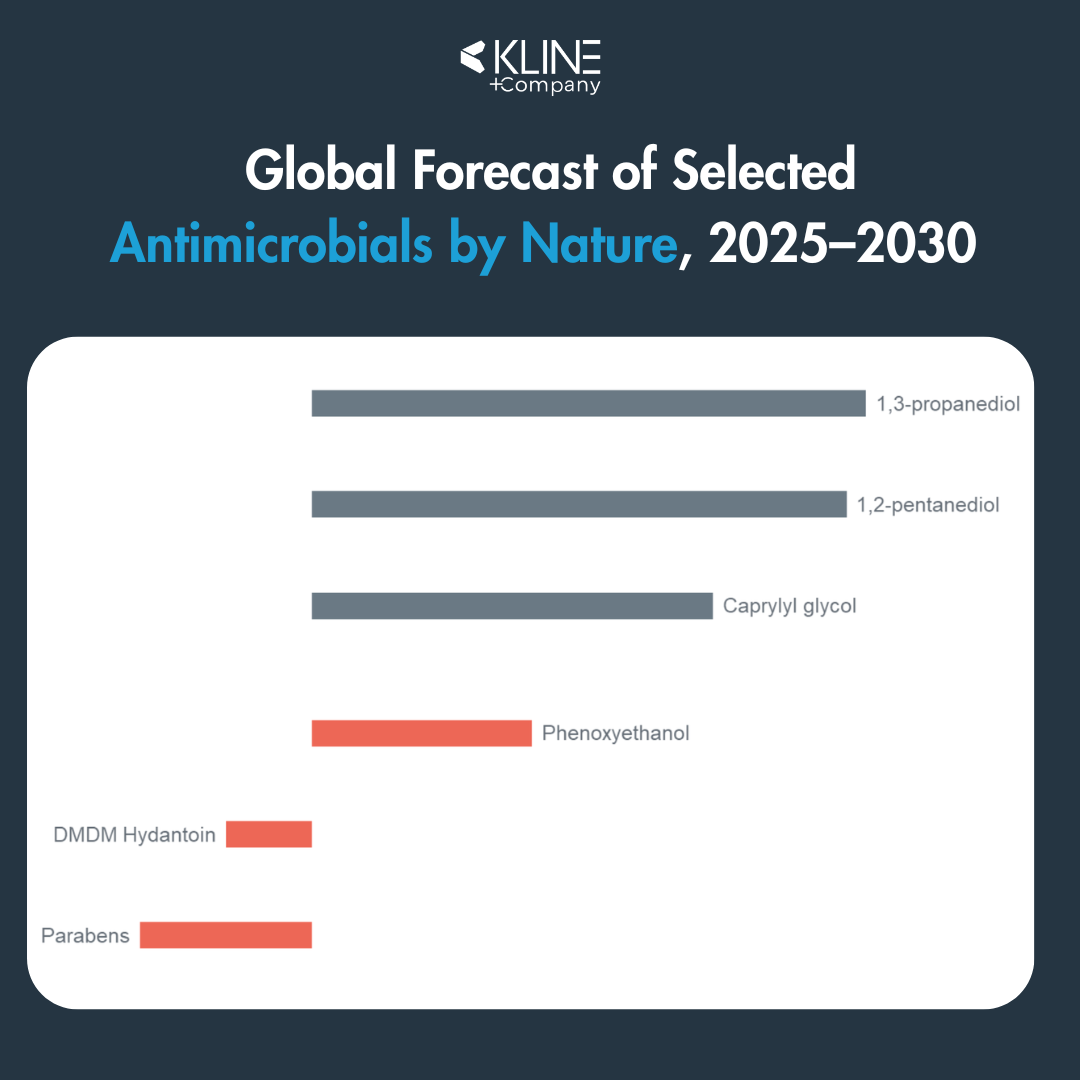
Preservation shows the pattern clearly. Kline’s forecast for selected antimicrobials to 2030 has naturally derived, multifunctional glycols, 1,3-propanediol, 1,2-pentanediol, and caprylyl glycol, gaining ground, while legacy synthetic preservatives such as phenoxyethanol, DMDM hydantoin, and parabens grow more slowly or decline. Formulators are trading established chemistry for nature-aligned alternatives that deliver a cleaner label without giving up efficacy.
The Pressure Points Brands Can’t Ignore
Three forces are raising the stakes:
Tightening regulation. Evolving EU rules on green claims and substantiation mean marketing language now carries compliance risk. “Natural,” “clean,” and “eco-friendly” increasingly require defensible backing.
Greenwashing scrutiny. As enforcement and public attention grow, unsupported claims are a reputational liability, not a marketing win.
Supply-chain transparency. Traceability, knowing and being able to show where a material comes from and its footprint, is becoming a procurement requirement, not a differentiator.
Together, these turn sustainability from a creative-team exercise into a cross-functional discipline spanning R&D, sourcing, regulatory, and marketing.
What It Means For Brands And Suppliers
The winners in this next chapter will be the ones who can connect a sustainability strategy to measurable, provable outcomes, and communicate them credibly. That requires a clear read on which claims are defensible, which ingredients and technologies are genuinely delivering, and where the market is heading rather than where it has been.
This is where objective, data-driven market intelligence earns its place: separating durable shifts from short-lived hype, benchmarking against the competitive set, and grounding sustainability decisions in evidence.
Turning Sustainability Into Advantage
Sustainability in personal care is maturing from message to model. The brands and suppliers who treat it as a measurable business strategy, not a claim, will define the category’s next decade.
Kline’s Sustainable Solutions advisory and personal care market research help ingredient and brand companies turn sustainability strategy into market advantage, grounded in independent data, not assumptions.
A version of this article was originally featured in HPC Today, Vol. 21(3), May/June 2026 (publisher: TKS TeknoScienze). This is Kline’s own adapted edition.