
Pooja Sharma
Senior Project Lead, Power & Utilities
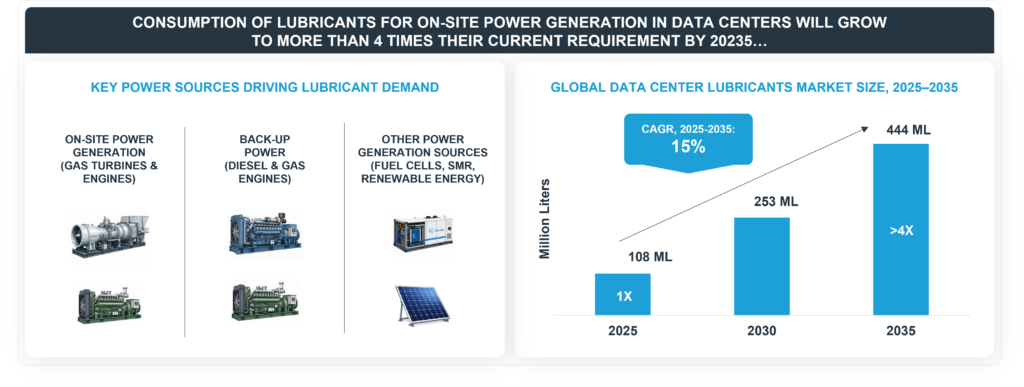
Lubricant demand in data centers is set to fire up, to become four times its current size by 2035. Utility power grids are becoming less reliable for compute-dense data centers that require 99.99% of power reliability. Data center operators are increasingly investing in sturdier stationary engine architectures and large-scale on-site power generation, especially via gas turbines. At-scale deployments of this equipment are turning data centers into industrial-size opportunities for lubricants, where moving fast and moving first have advantages.
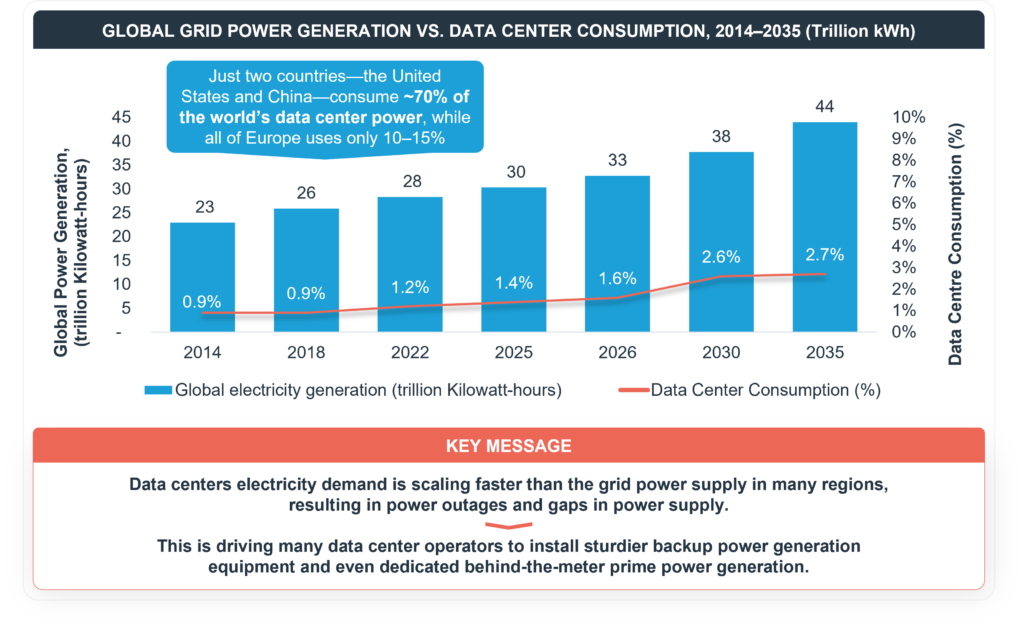
Source: IEA, Seconday Sources, and Kline and Company analysis
Data centers were once planned around land, fiber, cooling, and capital. Power was assumed to follow. That assumption is breaking down. The rapid expansion of artificial intelligence, cloud computing, and digital services is pushing electricity demand to levels that many grids were never designed to absorb at speed. According to the attached Kline analysis, global data center electricity consumption doubled between 2019 and 2025 and is expected to double again within the next five years. By 2030, data center electricity consumption could approach the current annual electricity consumption of a major industrial economy such as Japan.
The pressure is not only about more data centers. It is about more power-intensive data centers. AI workloads are changing the physics of digital infrastructure. Traditional racks that once drew roughly 4–5 kW have given way to AI systems drawing 100 kW-plus, with next-generation rack-scale architectures moving toward hundreds of kilowatts and potentially close to 1 MW per rack. As AI inference scales from model training to billions of real-time user requests, GPUs will run continuously, making power availability the decisive constraint on growth.
Data Centers are Shifting from a “Grid-First” To a “Power-First” Model
Data centers are increasingly shifting from a “grid-first” model to a “power-first” model, where developers secure reliable power, often on-site, before proceeding with data center construction. Utilities remain the preferred long-term source of electricity, but their ability to connect new capacities on required timelines is increasingly constrained. Transmission congestion, transformer shortages, permitting delays, and long interconnection queues are creating a widening gap between the pace at which data centers can be built and the pace at which grids can deliver power.
This mismatch is especially visible in the United States, where data centers can often be constructed in 18–36 months, while new transmission and substation infrastructure may require five to ten years. As a result, developers are turning to dedicated generation and hybrid energy architectures to accelerate deployment.
A Loud and Clear Industry Response: Sturdier Backup Architectures and Dedicated Behind-The-Meter-Power
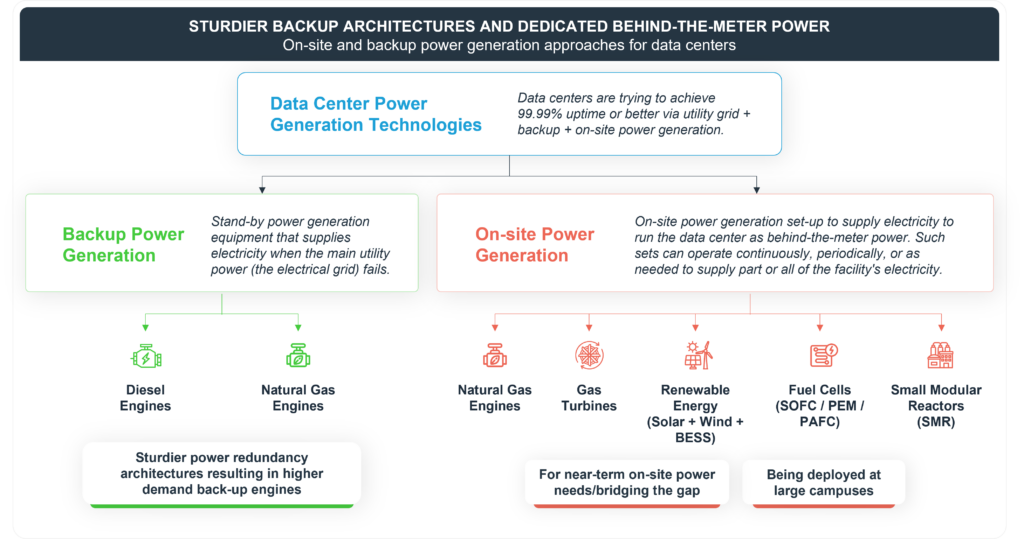
Hyperscale and AI facilities are increasingly adopting N+1, 2N and even 2N+1 redundancy models to protect uptime. At the same time, large campuses are exploring or deploying on-site generation not merely as emergency backup, but as bridge power, prime power, and in some cases, full-scale private energy infrastructure.
This mismatch is especially visible in the United States, where data centers can often be constructed in 18–36 months, while new transmission and substation infrastructure may require five to ten years. As a result, developers are turning to dedicated generation and hybrid energy architectures to accelerate deployment.
Back-Up Power Generation: The First Line of Defence
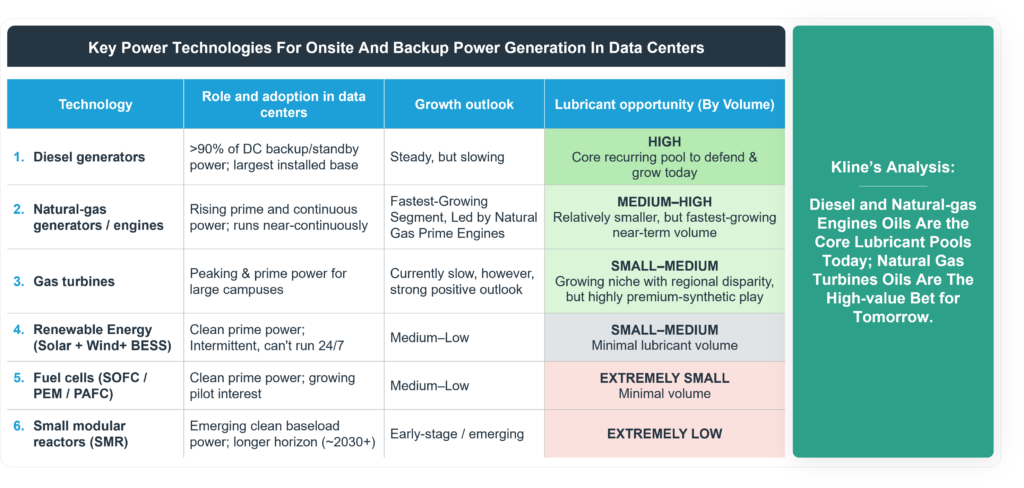
Diesel generators remain the backbone of data center resilience; they account for more than 90% of data center backup and standby power in many markets. Their advantages are well-understood: fast startup, proven reliability, mature OEM support, established service networks, and the ability to store fuel on-site. In critical infrastructure where seconds of downtime can trigger major financial and operational losses, these attributes remain powerful.
Kline and Company’s latest study on Power Lubricants for Data Centers unveils that the role of backup generation is becoming integral. As AI facilities grow larger and grid risk becomes more visible, backup systems are no longer viewed as passive insurance. They are becoming larger, more redundant, more closely monitored, and more integrated into facility planning. 2N architecture can effectively double the installed backup generation capacity compared with lower-redundancy designs, increasing the need for maintenance, testing, fuel management, and lubricant service even when generators run relatively few hours.
This mismatch is especially visible in the United States, where data centers can often be constructed in 18–36 months, while new transmission and substation infrastructure may require five to ten years. As a result, developers are turning to dedicated generation and hybrid energy architectures to accelerate deployment.
Natural Gas Engines: Dual Role of Back-Up and The Near-Term Power Bridge
Natural gas reciprocating engines are emerging as a critical technology in the data center power stack because they can serve two roles at once: reliable backup power and near-term bridge power while grid infrastructure catches up with AI-driven demand.
For backup applications, natural gas engines offer many of the reliability attributes data centers require: high availability, strong load-carrying capability, and the ability to start quickly in newer models. Compared with diesel generators, they also provide a cleaner emissions profile, making them increasingly attractive in locations where air-quality regulations are tightening or where operators are under pressure to reduce Scope 1 emissions.
The more important emerging role for natural gas reciprocating engines, however, is as bridge power. Natural gas reciprocating engines are emerging as one of the most practical near-term solutions, especially for data centers in high-growth markets such as North America that need power faster than the grid can provide. Natural gas engines help bridge the gap by providing on-site or behind-the-meter power that can be deployed in modular blocks and scaled as IT load grows. This makes them particularly well-suited for AI and hyperscale campuses.
Our analysis highlights this as a key reason why natural gas engines are currently seeing faster near-term adoption than gas turbines, which face longer manufacturing lead times.
Gas Turbines: The Strategic Bet For Large-Scale AI Campuses
If gas engines are the bridge, gas turbines are the long-term strategic play for large campuses. Natural gas turbines are increasingly relevant for utility-scale, behind-the-meter power systems serving AI factories and hyperscale data centers. They offer high output, strong reliability, flexible operation, and the ability to support baseload, peaking, or hybrid energy architectures. Aeroderivative turbines, in particular, can provide fast-start, modular power for campuses that cannot wait years for grid interconnection. For example, xAI’s Colossus campus in Memphis used mobile gas turbines for rapid on-site power deployment. Meta’s Ohio data center power model combines combustion turbines with reciprocating engines.
Most of the large turbine manufacturers, such as GE Vernova, Siemens Energy, Mitsubishi Power, Baker Hughes, and Solar Turbines, are seeing a surge in data center orders for gas turbines, which underscores that demand is shifting from backup-only systems toward multi-hundred-megawatt off-grid solutions. In some regions, policy is reinforcing the trend through “bring your own power” requirements or expectations for large-load customers to fund or provide their own energy infrastructure. The constraint, however, is supply. Large turbine delivery timelines can stretch for years, and even smaller turbine categories face longer lead times than many data center developers would prefer.
This means the future power architecture is likely to be hybrid: Diesel engines for sturdy and immediate back-up response, gas engines for modularity and bridging power needs; turbines for scale and efficiency and grid / distributed power wherever and whenever it can be secured.
Growth Enablers Beyond Power Equipment: Important Role of Lubricants
The build-out of backup and on-site power systems also creates a larger ecosystem of recurring service needs. Diesel generators require heavy-duty engine oils, condition monitoring, and periodic oil changes. Natural gas engines require low-ash gas engine oils designed for oxidation, nitration, and deposit control. Gas turbines require high-performance turbine oils, typically with strict OEM approval requirements and strong resistance to heat, oxidation, varnish, and contamination.
In volume terms, diesel engine oils remain the largest lubricant pool today because diesel backup fleets are so widespread. But the fastest-growing opportunity sits in natural gas engine oils, especially where gas engines support continuous or near-continuous power. Turbine oils are smaller in volume but higher in value, specification-driven, and strategically important as gas turbines become more prominent in large AI campuses.
The Future Data Center Will Be an Energy Platform
The next generation of data centers will not simply consume power; they will organize, secure, and in some cases, produce it. The most advanced campuses will increasingly resemble integrated energy systems: grid-connected where possible, backed by diesel or HVO-compatible standby generation, supported by natural gas engines, scaled by gas turbines, supplemented by batteries, and increasingly linked to renewable or low-carbon energy sources.
AI has made compute more powerful, but it has also made power more strategic. The winners in data center development will be those that can secure reliable electrons as efficiently as they secure GPUs. In that future, backup power is no longer a secondary safety system, and on-site generation is no longer an exception. Together, they form the new foundation of digital infrastructure.