
Laura Mahecha
Director, Professional Cleaning
For more than a decade, cleaning wipes were one of the most reliable volume engines in home care, healthcare, and industrial markets. Performance expectations were clear. Materials were familiar. Regulatory risk was manageable, but the market is seeing a paradigm shift. Today, cleaning wipes are perched at the intersection of sustainability regulation, chemical reformulation, and substrate innovation. The result is not incremental change but a structural reset in how wipes are designed, formulated, and commercialized. For chemical suppliers and substrate makers, this moment presents both disruption and opportunity. Success will depend less on selling individual inputs and more on delivering system-level solutions that anticipate regulation, enable performance, and simplify complexity for brand owners.
Sustainability is a design requirement, not just a product claim
Sustainability pressures have moved decisively upstream. What once lived in marketing briefs is now reshaping fiber choice, binder chemistry, additives, and manufacturing processes. On the substrate side, converters are accelerating away from polypropylene and PET toward cellulosic-rich constructions such as viscose, lyocell, wood pulp, bamboo, and hybrid structures that balance biodegradability with strength. Hydroentangled wet-laid and air-laid technologies are gaining share because they allow higher renewable content without synthetic binders. For chemical suppliers, this shift creates a cascade of consequences:
- Cellulosic substrates behave differently than synthetics: wetting, extractables, discoloration, tensile retention, and shelf-life change.
- Legacy additive packages and preservatives often overperform or outright fail in plastic-free systems.
- Compatibility testing becomes as important as efficacy testing.
In this environment, chemistry must be co-developed with substrates, not layered on top of them.
PFAS Elimination: The New Era of Co-Engineered Systems
Few issues are moving faster, or carrying greater risk, than PFAS regulation. Cleaning products are now explicitly targeted in multiple state bans and disclosure laws, and enforcement timelines are accelerating. Historically, fluorochemicals quietly solved a range of functional challenges:
- Soil release
- Oil repellency
- Slip and smear control
- Anti-foaming and wetting consistency
Those tools are disappearing. Substrate manufacturers are responding by shifting performance from chemistry to structure: fiber geometry, basis weight, embossing patterns, and capillarity. Chemical suppliers are under pressure to deliver PFAS-free surfactants, wetting agents, and formulation aids that perform without persistence. The implication is clear: performance is being redistributed across the system. What chemistry can no longer do alone; substrates must help deliver—and vice versa.
From Niche to Mainstream: The Rise of Bio-Based Chemistry
Another quiet transformation is underway: cleaning efficacy is becoming more biochemical than chemicals. Enzymes: proteases, lipases, amylases, are increasingly used in wipes to break down soils at the molecular level. Bio-based surfactants and biosurfactants are replacing petrochemicals to meet sustainability and toxicity goals. For suppliers, this opens new doors, but also introduces new complexity:
- Enzymes demand tight control of pH, water activity, and preservatives
- Substrates must allow controlled release while maintaining stability over shelf life
- Traditional biocides may deactivate enzymes, forcing formulation redesign
The winners will be suppliers who understand not just enzyme performance, but how substrates store, protect, and release biological actives.
Gentler Chemistry, Higher Expectations
Post-pandemic scrutiny has permanently raised the bar for safety and residue control, especially in healthcare, foodservice, and electronics environments. Formulations are trending toward:
- Lower VOC content
- Reduced harsh quaternary systems
- Minimal residue and odor profiles
- Clear regulatory alignment between cleaners and disinfectants
This, in turn, raises the bar for substrates:
- Lower lint and particulate generation
- Controlled extractables
- Consistent absorption and release
In effect, substrates are no longer passive carriers. They are now functional components of risk management, regulatory compliance, and product performance.
The Substrate Is Becoming the Cleaning Tool
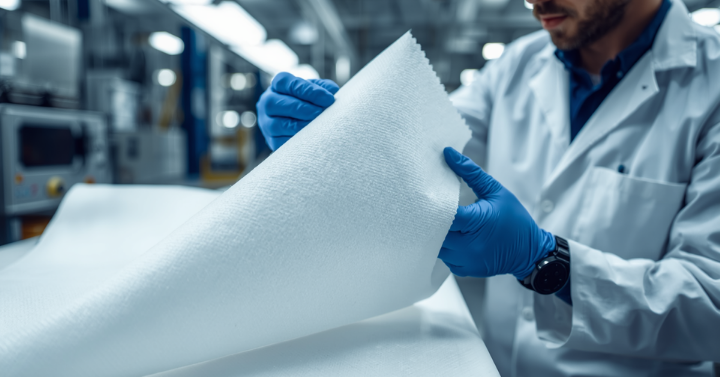
One of the most important industry shifts is also the simplest: the wipe does more of the cleaning work itself. Advanced spunlace structures, engineered cellulose blends, and microfiber-like nonwovens increasingly deliver:
- Higher soil pickup efficiency
- Mechanical removal of contaminants
- Reduced reliance on aggressive chemistry
For chemical suppliers, this changes the value equation. Performance gains may come from using less chemistry more intelligently, supported by a better substrate. For substrate makers, it elevates the conversation from cost-per-square-meter to cleaning system performance.
Fragmented Regulation Is Driving Collaboration, or Failure
Finally, regulatory fragmentation across the EPA, FDA, CPSC, and state chemical laws is driving SKU proliferation and complexity for brand owners. They are looking upstream for help. Suppliers who succeed will be those who offer:
- Platform substrates compatible with multiple formulations
- Chemical systems pre-aligned with future regulation
- Joint validation data that simplifies customer decision-making
This is not a moment for siloed innovation. It is a moment for supplier collaboration.
Opportunity Lies in Integration
The future of cleaning wipes will not be defined as the best fiber, the strongest surfactant, or the most elegant enzyme alone. It will be won by those who employ integrated systems from the start, where:
- Substrates deliver mechanical performance
- Chemistry delivers targeted, responsible efficacy
- Both are designed together, with regulation and sustainability built in from the start
For chemical suppliers and substrate manufacturers, this reset is uncomfortable, but it’s also a chance to move upstream, deepen partnerships, and redefine value.
This year, Kline will be conducting a deep dive into the upstream value chain for both substrates and chemical formulations in wet wipes in Material Components of Cleaning Wipes 2026, covering the U.S. and Europe. We will also examine the professional finished goods wet wipes and dry wipers in our well-regarded I&I Cleaning Wipes 2026 U.S., to be published in Q4 2026. For more information on how Kline’s market intelligence can inform your company’s strategy in wipes, please contact us.