
Laura Mahecha
Director Professional Cleaning Products
With National Cleaning Week coming up in the United States from March 30 to April 2, 2026 , let’s take a closer look at two key trends impacting the industry: Sustainability and dilution & dispensing systems.
End users are prioritizing sustainability in their cleaning operations. Generally, this manifests as cleaner product ingredients but is often focused on the increased use of post-recycled content packaging, water and energy conservation, and concentrated formulas. A majority of those surveyed indicate a willingness to pay more for green cleaning products.
A recent Kline + Company’s end user survey reveals that greener chemistries are the most prevalent sustainability initiatives; however, reducing plastic waste and using products in recycled-content packaging are also done by two-thirds of respondents. Water and energy conservation are also important initiatives related to cleaning operations.
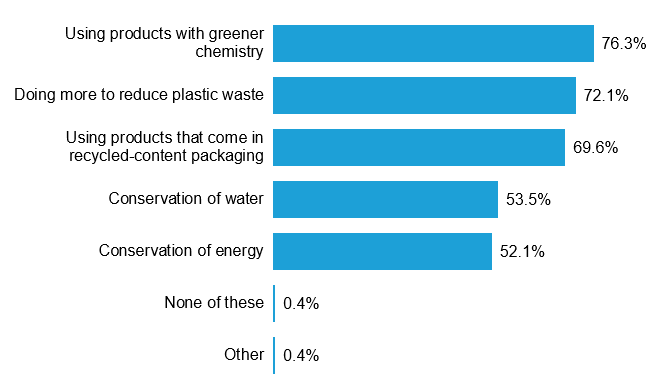
Source: Kline + Company’s Janitorial and Housekeeping Cleaning Products 2025 study.
Part of those initiatives to reduce water and energy usage at industrial and institutional facilities is the use of dilution and dispensing systems for cleaning chemicals. Estimated 72% of recent survey respondents indicate that they use dilution and dispensing systems at their facilities and that 29–49% of all chemicals used are dispensed through such systems.
Key reasons why end users like these systems are employee safety/training and better cleaning from correct dilution, while cost efficiency is another reason to use these systems.
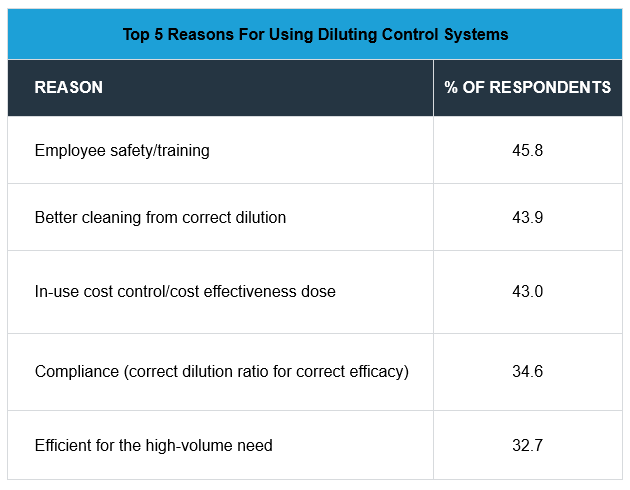
Source: Kline + Company’s Janitorial and Housekeeping Cleaning Products 2025 study.
Similar trends are evident in the Europe market for professional cleaning products. The janitorial cleaning industry in Europe is undergoing significant transformation, driven by technological advancements, sustainability imperatives, and evolving regulatory landscapes. Moreover, recently, Clorox announced the acquisition of GOJO, and this may have future implications on the combined professional brands of this portfolio in Europe. Some of the key trends that are expected to shape the industry through 2026 are:
- Heightened Health and Hygiene Standards: Post-pandemic, there is sustained demand for high-standard cleaning, with businesses requiring certified sanitizers, and disinfectants are used along with digital disinfection logs. Cleaning is now linked to well-being and indoor air quality, especially in sectors such as healthcare and hospitality.
- Sustainability and Circular Economy: Sustainability has become a core expectation rather than a differentiator. The industry is adopting low-water and energy-efficient technologies, biodegradable chemicals, and circular packaging systems. These practices are increasingly tied to procurement requirements and cost control, driven by EU environmental regulations.
- Workforce Challenges: The sector faces labor shortages and rising workforce expectations. Automation helps offset these challenges but requires skilled oversight.
- Data-Driven and Smart Cleaning: The use of IoT and real-time monitoring is revolutionizing cleaning schedules, which are now based on actual facility usage. Smart systems and AI-driven tools optimize cleaning operations, improving efficiency and reducing waste. Integrated hygiene programs and digital inspection tools are becoming mainstream, consolidating vendors to improve quality and support ESG data reporting.
- Automation, Robotics, and AI Integration: Automation is becoming standard in cleaning operations to address labor shortages and enhance efficiency. Autonomous robots and AI are taking over repetitive tasks, allowing human workers to focus on supervision and specialized roles. EU regulations, such as the upcoming AI Act, ensure responsible deployment of these technologies.
- Procurement Reforms: EU policy changes are shifting the focus from cost-driven to quality-driven contracts, embedding sustainability and labor standards as core criteria. This aims to improve working conditions and service quality.
Europe’s janitorial industry is evolving toward a more technology-enabled, environmentally responsible, and highly regulated future. Quality and accountability are paramount, shaping a landscape where advanced automation, sustainability, and professionalization are key drivers. The away-from-home cleaning market in Europe is characterized by leading MNCs and local players alike competing in a tight market.
With 2026 insights and fresh updates to be published later this year, Janitorial Cleaning Products in Europe study covers France, Germany, Italy, Spain, and the United Kingdom. Based on hundreds of end user surveys to gain insights into the usage, preferences, and business critical issues impacting end users. The study will help inform your business and learn about the Europe professional cleaning market size, end-use segment share, supplier share, growth, trends, and opportunities. To learn more, contact us.