For decades, beauty and oral care have occupied separate worlds. Beauty has focused on aesthetics, self-expression, and increasingly sophisticated routines, while oral care has remained rooted in hygiene, prevention, and functional efficacy.
Those boundaries are beginning to blur.
As longevity evolves from a niche wellness concept into a mainstream consumer priority, consumers are increasingly viewing health, appearance, and aging through a more holistic lens. Kline and Company’s longevity research highlights how beauty is expanding beyond traditional categories as wellness, aesthetics, preventative healthcare, and beauty continue to converge. The focus is no longer simply on looking good, but on maintaining vitality, function, and wellbeing over the long term.
This shift is creating opportunities for categories once considered outside of beauty’s traditional boundaries.
One category we’re watching closely is oral care.
As consumers increasingly embrace a “feel good to look good” mindset, oral care is becoming an extension of self-care rather than simply a daily hygiene task. The category is evolving across everyday products, premium brands, professional treatments, and cosmetic procedures, creating new opportunities for companies across beauty, personal care, healthcare, and wellness.
Oral care is undergoing a transformation reminiscent of the early days of indie skin care
The evolution of oral care has clear parallels with what happened in skin care as independent brands began challenging traditional category conventions.
Products that were once largely functional became more desirable through premium packaging, sophisticated formulations, distinctive brand stories, and a stronger focus on the consumer experience.
Oral care is beginning to follow a similar path.
New brands are bringing modern aesthetics, ritual, sensory experience, and science-led positioning into a category historically dominated by clinical language and mass-market brands. The result is a broader proposition that can appeal to consumers looking for efficacy, but also experience, design, and a stronger connection to their wider wellness routines.
Interest in the category is rising; consumer expectations are changing.
FIG. 1 Where interest in oral care is growing.
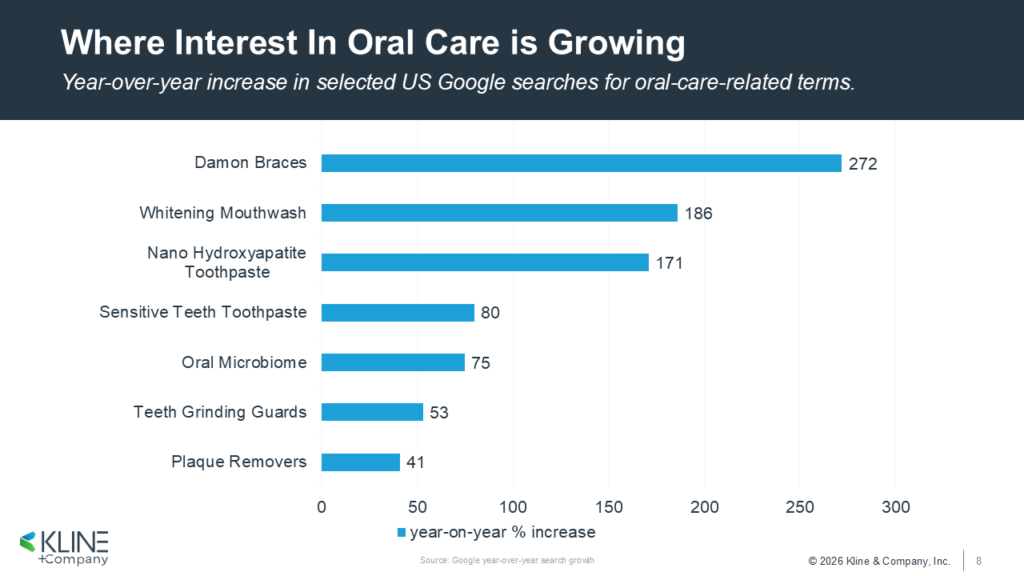
US Google searches for oral care products have increased 11.3% year-over-year, while oral care product activity on TikTok has grown 6.6%. Almost 32% of online conversation around oral care takes place on Reddit, highlighting the extent to which consumers are actively seeking information, recommendations, and solutions within the category.
The areas attracting attention are also becoming more specialized.
Searches for Damon Braces have increased 272% year-over-year, while Whitening Mouthwash is up 186% and Nano Hydroxyapatite Toothpaste is up 171%. On TikTok, #teethwhitening generates 69.1 million weekly views.
Other needs are gaining traction too. Searches for Sensitive Teeth Toothpaste are up 80%, Teeth Grinding Guards 53%, and Plaque Removers 41%, while interest in the Oral Microbiome has increased 75%.
The category is becoming more specialized, with demand spanning specific health needs, aesthetic outcomes and broader wellbeing.
The Brands Redefining Oral Care.
The transformation is, perhaps, most visible in the brands entering the category.
While their propositions differ, they’re each moving the sector beyond traditional oral-care conventions. For established players, these brands are worth watching not simply because of their aesthetics, but because they demonstrate different routes to premiumization, differentiation, and growth.
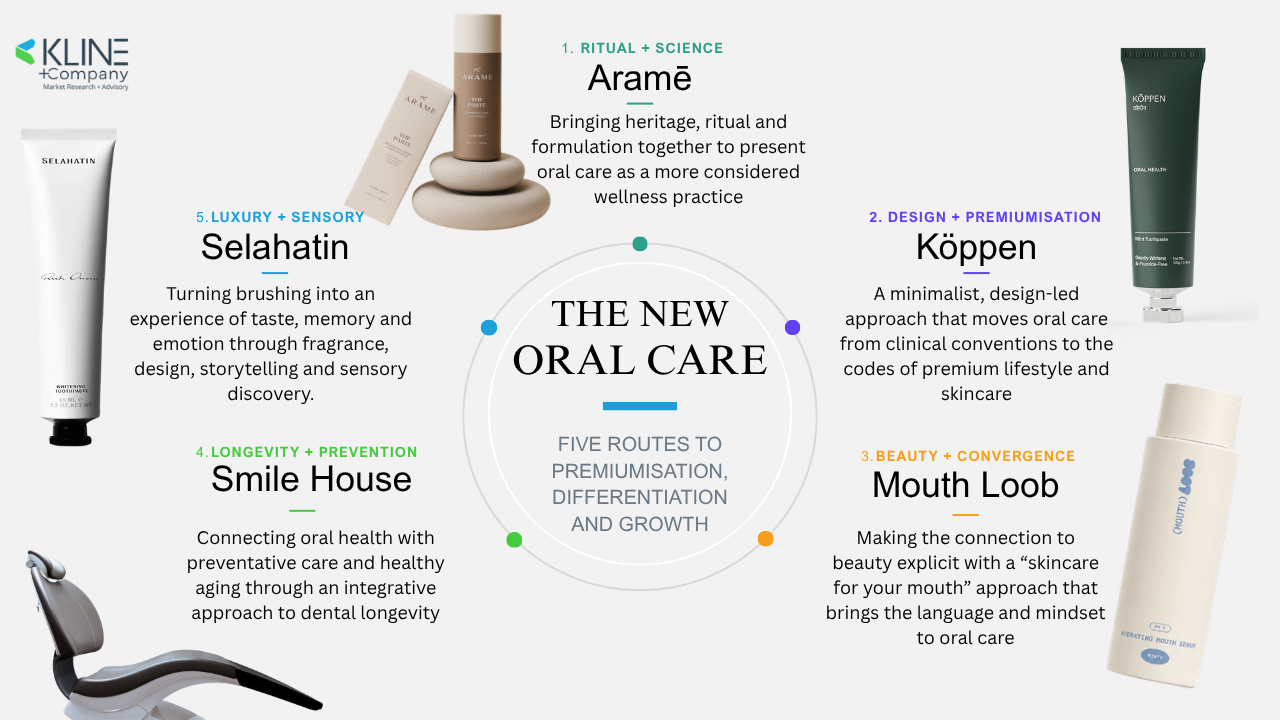
Aramē: Ritual and science
Arame combines inspiration from ancient oral-care rituals with modern science. Its positioning brings heritage, ritual and formulation together, presenting oral care as a more considered wellness practice.
Köppen: Design-led premiumization
Köppen takes a minimalist, design-led approach with its “oral care, reimagined” positioning. Its visual language moves away from the clinical conventions of traditional oral care and towards the codes of premium lifestyle and skin care brands.
Mouth Loob: Bringing beauty into oral care
Mouth Loob makes the connection to beauty explicit with its “skin care for your mouth” positioning. It is perhaps the clearest example of beauty and oral care converging, applying the language and mindset of skincare directly to the mouth.
Selahatin: Luxury and sensory experience
Selahatin takes a luxury and sensory approach, positioning brushing as an experience involving taste, memory, and emotion. The brand demonstrates how fragrance, design, storytelling, and experience can create differentiation alongside functional efficacy.
Smile House: Oral care meets longevity
Smile House takes the longevity proposition further, describing its approach as “the integrative approach to dental longevity.” Its positioning directly connects oral health with preventative care and healthy aging.
Together, these brands show that there is no single route to the next generation of oral care. Some are building around ritual, others around design, luxury, sensory experience, science or longevity.
What they share is a willingness to rethink what oral care can be.
From Oral Care to Oral Aesthetics
The convergence between oral care and beauty is not limited to products used at home.
The wider beauty market is expanding into treatments and procedures, with consumers combining products, professional services and aesthetic interventions to achieve specific outcomes.
BCG + WWD’s 2026 ‘Beauty, Optimized’ report identifies a group of highly engaged “Optimizers” who are particularly active across beauty, aesthetics, performance and longevity. Around 6% of US adults, approximately 15 million consumers, fall into this group, and around 70% consider aesthetics a core or regular maintenance part of their routine.
Dental treatments are part of this expanding aesthetic ecosystem.
BCG identifies orthodontics, professional teeth whitening, and cosmetic dental as part of the next frontier of aesthetic procedures as facial aesthetics mature.
There is also an interesting gender dimension. Within the Optimizer cohort, cosmetic dental has a 2.4x index among men compared with women, suggesting that oral aesthetics could be an important part of the expanding male beauty and self-care opportunity.
The traditional distinction between everyday oral hygiene and cosmetic dentistry is becoming less clear. Whitening products can sit alongside professional whitening. Orthodontics can have both functional and aesthetic motivations. Cosmetic dental treatments can become part of a wider approach to appearance, confidence and self-care.
For companies operating in the category, this means the addressable market is no longer defined solely by toothpaste, mouthwash, and traditional dental care. It increasingly spans at-home products, professional services, aesthetics and preventative health.
A natural adjacency for physician-led beauty
There is also a potential opportunity for physician-led and professional beauty businesses.
Medical-dispensed skin care brands have spent decades building trusted physician networks and highly engaged patient ecosystems around healthy aging, preventative treatments, and long-term skin health. As longevity becomes a larger strategic focus, oral care represents a natural adjacency to these established ecosystems.
The overlap between aesthetics, wellness, preventative healthcare, and physician-guided recommendations creates opportunities for innovation across both products and services. The growing presence of dental and cosmetic dental services within the broader medical-aesthetic landscape adds another dimension to this opportunity.
Many consumers seeking solutions for skin longevity are also interested in broader health optimization. For physician-dispensed brands and professional channels, oral care could provide another touchpoint within an ecosystem built around expertise, trust, and ongoing engagement.
The opportunity is not necessarily to replicate existing oral-care propositions, but to consider where oral health and aesthetics can complement existing longevity and healthy-ageing portfolios.
Beauty Is Becoming A Broader System Of Care
The evolution of oral care sits within a much wider shift in beauty.
BCG’s research shows that Optimizers are combining traditional beauty products with aesthetic procedures and solutions focused on performance and longevity. 80% say beauty is about how they feel physically and mentally, while their spending spans products, procedures and broader performance and longevity solutions.
Consumers are increasingly looking for solutions that support appearance, confidence, physical wellbeing and long-term health. The traditional boundaries between beauty, wellness and health are becoming less important.
Oral care sits naturally within this space.
It combines preventative health with a visible aesthetic dimension. It can address both function and appearance, and it spans everyday products, professional services and increasingly sophisticated treatments.
For companies across beauty, personal care, healthcare, and wellness, that makes oral care an interesting adjacency to watch.
“Just as skincare evolved from basic cleansing to a sophisticated wellness ritual, oral care is beginning its own transformation, fuelled by longevity, self-care, and premiumisation.”

Corrine Maier
Engagement & Business Development Manager
KLINES VIEW
What Does This Mean For The Market?
For established oral-care players, the opportunity is not simply to make existing products more premium.
The competitive landscape is changing as new entrants introduce propositions built around design, ritual, science, luxury, wellness, and longevity. Established brands will need to consider where future growth is coming from, which emerging propositions have the potential to scale, and how changing expectations may reshape the category.
For beauty and wellness companies, oral care represents an increasingly credible adjacent opportunity. The emergence of brands such as Mouth Loob and Selahatin demonstrates that the category can support premium, beauty-led propositions, while Smile House points towards a longer-term opportunity around preventative health and longevity.
For companies operating across professional and consumer channels, cosmetic dental treatments add another dimension. The opportunity may increasingly sit across the relationship between at-home care, professional treatment, aesthetics, and long-term oral health.
For businesses looking across the wider beauty landscape, oral care provides a useful example of a broader shift: category boundaries are becoming less important than the need or outcome being addressed.
This is where the opportunity becomes particularly relevant from a market strategy perspective.
Understanding how categories are converging, which brands are creating new propositions, where competitive pressure is emerging and which adjacent markets offer credible opportunities is increasingly important for companies looking to identify their next areas of growth.
Kline’s work across beauty, personal care, and adjacent markets, including our longevity research and custom advisory work, looks at these shifts through a market and strategic lens, helping companies understand where consumer needs, innovation, competitive dynamics, and category boundaries are creating new opportunities.
Oral care is a good example of this type of convergence.
What to watch next
- The continued premiumization of oral care
Will design, sensory experience, and luxury positioning move beyond a small number of challenger brands and become mainstream expectations?
- The expansion of oral aesthetics
As whitening, orthodontics, and cosmetic dental become increasingly connected to the wider beauty ecosystem, where will the boundaries between oral care and aesthetic treatments settle?
- The rise of preventative and microbiome-led propositions
Growing interest in the oral microbiome and more specialized health needs could create opportunities for brands that combine scientific credibility with accessible consumer propositions.
- The convergence of beauty, wellness, and longevity
As consumers increasingly move between products, procedures and preventative solutions, companies will need to look beyond traditional category definitions when identifying future growth opportunities.
Beyond the smile
Oral care is becoming more than a hygiene category.
The evolution of the market reflects a broader shift in how consumers think about beauty, health and aging. As longevity becomes a mainstream consumer priority, the focus is increasingly on maintaining vitality, function, appearance and wellbeing over the long term.
For companies, that creates both opportunity and competition.
The next wave of growth may come from identifying where traditional category boundaries are breaking down, understanding which brands and propositions are gaining traction, and assessing where adjacent opportunities can create meaningful growth.
Oral care is an example of this shift.
And that makes it one of the most interesting categories to watch.