

Amrita Singh
Project Lead, Power & Utilities
How important are regulations in the white oil market? In India, roughly 85% of white oil demand is pharmaceutical grade. In China, the equivalent figure is about 16%. It is a striking difference, but this is not because one country is more regulated than the other. It reflects fundamentally different end-use markets. China has substantial demand from textiles, unlike India with lower textile demand but higher inclination toward personal care and pharmaceuticals, food-contact, and other applications requiring pharmaceutical-grade material.
This variance shows that pharmaceutical grade does not necessarily mean pharmaceutical end use. White oil purity grades reflect the requirements of the applications being served, as well as national regulations, domestic production capabilities, and trade patterns. Two countries can therefore have similar grade profiles for very different commercial reasons.
This is where global figures can be misleading. Across the 12 country markets covered in detail by Kline’s Global White Oils: Market Analysis and Opportunities, pharmaceutical grade accounted for about 62% of combined demand in 2025 globally, expected to rise to approximately 63% by 2030. The aggregate share is relatively stable, but it conceals substantial differences between individual countries.
A global view of premiumization is not sufficient to determine which grades, approvals, or routes to market will be required in a particular country. Country-level application demand must be understood first.
Three Purity Profiles, Not One Global Trend
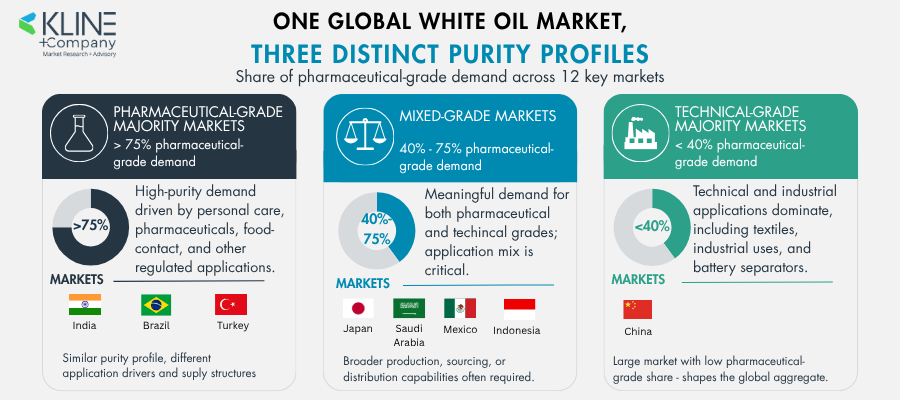
Grouping the 12 markets by their pharmaceutical-grade share reveals three broad purity profiles.
This is an initial planning lens rather than a complete market strategy. Markets within the same group may still differ considerably in their applications, production structures, import dependence, and regulatory requirements.
Pharmaceutical-Grade Majority Markets
The study identifies three distinct purity-demand profiles across the 12 key markets, each requiring different portfolio, approval, and go-to-market strategies.
Yet a similar purity profile does not mean that these markets function in the same way. In India, the high pharmaceutical-grade share is driven substantially by plastics and food-contact applications rather than pharmaceutical manufacturing alone. Brazil exhibits a different supply structure, creating distinct sourcing dynamics relative to other high-purity markets.
These examples show why purity share must be interpreted alongside application and supply-chain data. Grade mix tells a supplier what a market consumes but not necessarily who buys it, why that grade is required, or how the demand is served.
Mixed-Grade Markets
Japan, Saudi Arabia, Mexico, and Indonesia sit between 40% and 75% pharmaceutical-grade demand. These markets contain meaningful demand for both pharmaceutical and technical grades, making application mix particularly important when assessing portfolio requirements.
However, the mixed-grade label should not be treated as evidence that suppliers or buyers can freely choose between grades. The appropriate grade remains determined by the intended application and its specification. Instead, the profile indicates that suppliers may need broader production, sourcing, or distribution capabilities to address more than one part of the market.
Technical-Grade Majority Markets
China is the only market in the 12-country analysis where pharmaceutical grade represents less than 40% of demand. It accounts for approximately one-third of the combined demand measured across the 12 markets, meaning that its application structure has a substantial effect on any aggregate market view.
China’s profile is shaped by its concentration in textiles and other industrial applications, alongside demand from lithium-ion battery separators. A supplier interpreting the global pharmaceutical-grade share as evidence of a uniform shift toward higher-purity material would therefore overlook a major market in which technical-grade applications remain central.
Grade Demand and Market Access Are Different Questions
A country’s purity profile indicates the grades consumed by its end-use industries. It does not, on its own, show whether an individual supplier can access those applications.
White oils are subject to national health, safety, and industrial standards that establish criteria for purity, composition, and permitted use. Some countries adopt the United States Pharmacopeia directly, while others use specifications that align with it to varying degrees. This creates partial harmonization in quality requirements and test methods; however, suppliers must still address the applicable national, application-specific, and customer requirements in each market.
In many regulated applications, meeting purity requirements is only the first hurdle. Moreover, application-specific approvals, certifications, documentation, and customer qualification processes can have an equally important influence on market access. Approvals and supporting capabilities can consequently become commercial assets, as they help suppliers demonstrate that their products meet the required specifications and that quality can be maintained consistently. However, they are not the only source of advantage. Product availability, technical support, distribution reach, and supply reliability may also influence competitive position.
The Commercial Lesson
A pharmaceutical-grade share shows you what a market consumes. It does not indicate who the key customers are, which applications drive demand, where competitive advantages exist, or whether your organization has the approvals and capabilities required to participate. Those answers determine commercial success. Kline’s Global White Oils: Market Analysis and Opportunities goes beyond market sizing to reveal the application drivers, grade requirements, regulatory landscape, supplier positioning, and growth opportunities across 12 strategically important markets, helping suppliers turn market data into actionable growth strategies.