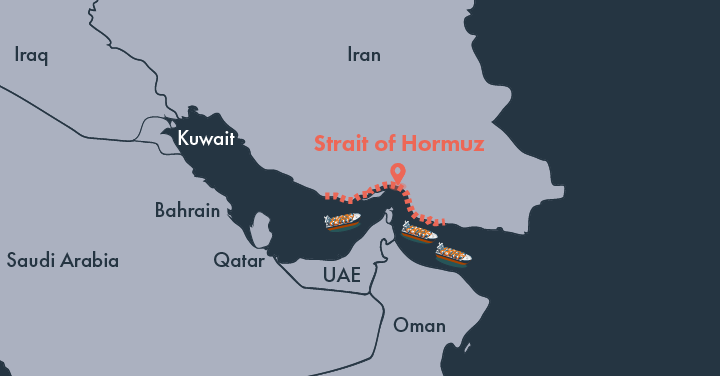
Recent geopolitical developments in the Middle East have renewed attention on the stability of global trade routes and supply chains. Tensions affecting key maritime corridors, including the Strait of Hormuz, have disrupted shipping movements, increased freight and insurance costs, and led some carriers to reroute vessels or suspend transits through higher-risk areas.
These developments highlight how closely global energy, chemicals, and materials markets remain tied to a limited number of strategic production hubs and trade corridors, often revealing which supply chains are resilient and which are more vulnerable to disruption.
Global Trade Flows and Export Dependence
The Middle East remains one of the most export-oriented chemical regions globally. Asia is the primary destination, receiving around two-thirds of GCC chemical exports, followed by Europe and Africa.
The majority of exports transit the Strait of Hormuz before reaching global markets. From there, shipments move east toward Asian manufacturing hubs or west through the Suez Canal corridor toward Europe and the Mediterranean. The region’s role in polymers is particularly significant. The Middle East accounts for roughly 40% to 45% of globally traded polyethylene and polypropylene, meaning a large share of global polyolefin supply originates in the Gulf and is exposed to disruptions affecting the Strait of Hormuz. Other key petrochemical exports include agri-nutrients (e.g., Urea and ammonia), aromatics and intermediates such as MEG and Styrene. Value-added and specialty chemicals make up a much smaller share of the region’s exports, generally estimated at below 10%.
While disruptions around the Red Sea and the Suez Canal have drawn significant attention in recent months, the Strait of Hormuz remains a critical chokepoint for global petrochemicals trade. Unlike the Suez Canal, which primarily affects shipping routes and transit times, the Strait of Hormuz serves as the main export corridor for Gulf chemical production.
Stress-Testing the Chemicals and Materials Supply Chain
The impact on chemicals and materials markets will depend on both the duration of disruption and the extent to which regional production or export corridors are affected. The scenarios below illustrate how different combinations of these factors could shape market outcomes.
Scenario A: Short Disruption with Limited Structural Impact
A brief escalation with minimal direct impact on regional chemical production or export infrastructure. This scenario seems less likely at the moment as shipping movement across the Strait of Hormuz has mostly stopped.
- Shipping routes remain operational, although freight costs, insurance premiums, and transit times increase temporarily.
- Short-term price volatility may emerge in globally traded products such as polymers, methanol, and fertilizers.
- As logistics conditions stabilize, trade flows and pricing gradually normalize.
Scenario B: Short but Severe Supply Disruption
A brief but intense disruption affecting key export corridors or regional infrastructure.
- Temporary constraints on exports tighten global supply for several chemical product chains.
- Prices remain elevated for a period as markets adjust inventories and sourcing strategies.
- Trade flows gradually rebalance once logistics conditions normalize.
Scenario C: Prolonged Period of Elevated Tension
An extended period of geopolitical tension with limited direct damage to chemical production assets.
- Freight rates, insurance premiums, and risk surcharges remain elevated.
- Periodic disruptions at ports or shipping corridors create localized supply imbalances across regions or product grades.
- Higher energy prices increase feedstock costs and contribute to broader economic uncertainty.
Scenario D: Prolonged Structural Disruption
A sustained conflict affecting regional chemical production, export infrastructure, or major shipping corridors.
- Export flows from the region are materially constrained for an extended period.
- Global trade flows adjust as buyers diversify sourcing and producers redirect volumes across markets.
- Chemical markets experience prolonged price volatility and supply imbalances.
On the Ground Observations
Anecdotal feedback indicates that the impacted regions are seeing early upstream cost pressure, including price increases in selected raw materials.
Some early signs of precautionary buying are emerging as suppliers are seeing a spike in demand from some clients potentially with intent to build inventory buffers in anticipation of extended disruption, behavior that closely mirrors COVID-era dynamics. This perception-led pattern can further accelerate price volatility in a market which is suffering from input cost inflation.
For market participants, this underscores the importance of monitoring not only physical supply constraints but also behavioral shifts across the value chain.
The Region’s Strategic Advantage: Operational Optionality
Since late 2023, disruptions in the Red Sea corridor have forced many shipping lines to bypass the Suez Canal and reroute around the Cape of Good Hope, raising freight costs and extending transit times between Asia and Europe. Despite these pressures, GCC chemical producers have largely maintained supply continuity to global markets.
Integrated production complexes, access to advantaged feedstocks, and proximity to major maritime corridors give GCC producers multiple levers when conditions change.
When logistics routes tighten, companies can adjust shipping routes, redirect cargo flows, or reposition inventory to maintain deliveries. These adjustments, however, come at a cost. Longer routes increase freight rates, working capital requirements, and delivery times, and these costs must ultimately be absorbed along the value chain, either by the producers or by the downstream buyers.
In an environment where reliability increasingly matters as much as price, the ability to maintain supply through logistical disruptions remains a key competitive differentiator. While geopolitical developments may periodically introduce volatility into shipping routes and freight costs, the region’s scale, integrated infrastructure, and operational flexibility allow producers to adapt and sustain their role in global chemicals supply chains.