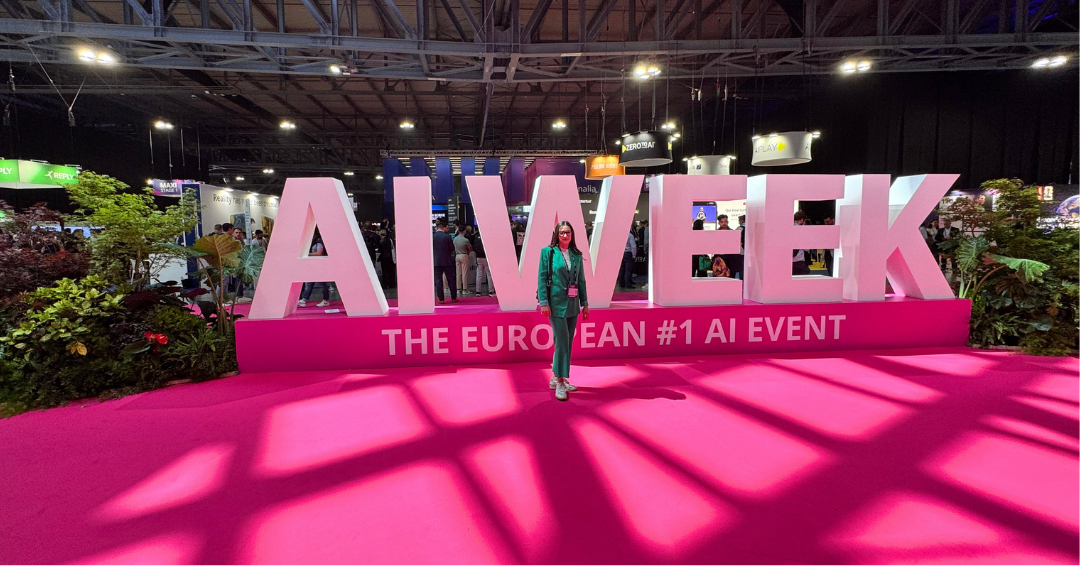
AI Week Milan made one thing very clear: enterprise AI is entering a new phase of maturity.
The conversation has moved beyond experimentation, generic chatbots, and isolated productivity tools. Across keynote sessions, case studies, and technical demonstrations, the focus was instead on operational deployment at scale; AI systems embedded directly into business workflows, enterprise decision-making, and organizational infrastructure.
What stood out most throughout the event was not futuristic speculation, but pragmatism. Companies are no longer asking whether to adopt AI. They are asking how to operationalize it responsibly, integrate it into existing systems, govern it effectively, and generate measurable business value from it.
For industrial and B2B organizations, this shift has major implications.
AI Agents Are Becoming Enterprise Infrastructure
One of the dominant themes throughout AI Week Milan was the rise of AI agents and multi-agent systems. Unlike traditional copilots or chat interfaces, these systems are designed to execute workflows autonomously across enterprise functions. AI is evolving from assistant employees occasionally used into an operational layer embedded directly into business processes.
This shift was visible across procurement, customer service, compliance, operations, cybersecurity, and enterprise analytics.
The evolution can be summarized in three phases:
- AI assisting humans,
- AI executing operational tasks
- AI coordinating workflows autonomously.
Most enterprise deployments showcased at the event now appear to sit somewhere between phases two and three.
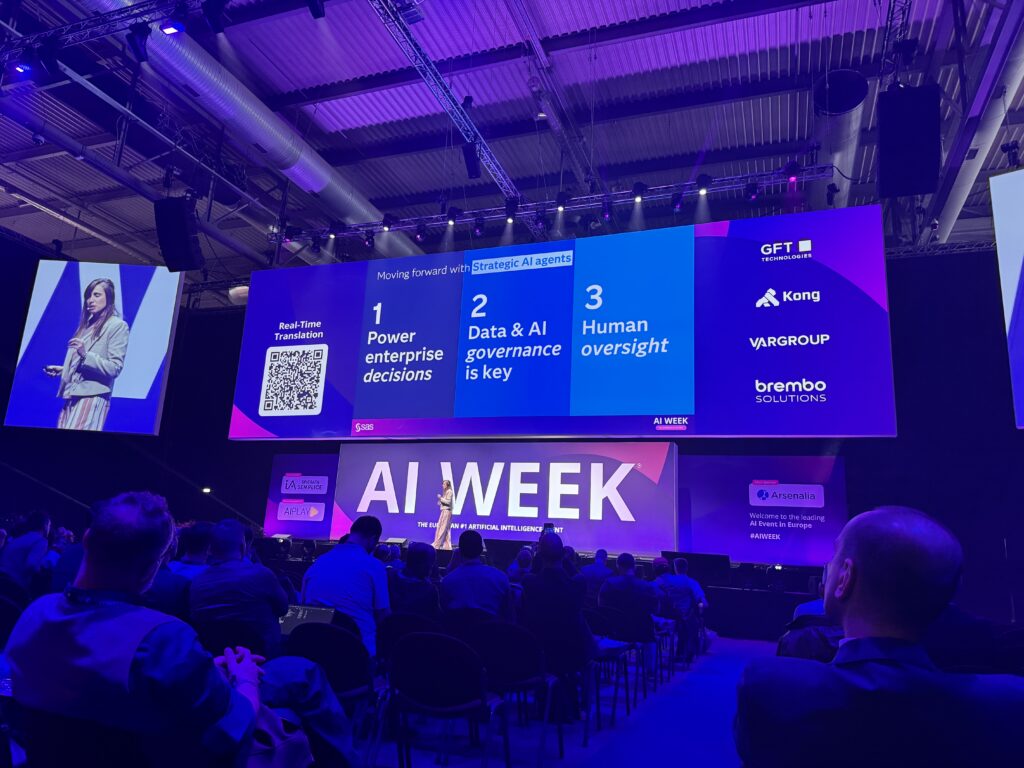
A particularly interesting session focused on “Strategic AI Agents,” emphasizing that enterprise value does not come from AI generating generic answers, but from connecting AI systems to trusted enterprise data, business rules, and operational decision-making frameworks.
The message was consistent throughout the conference: AI becomes strategic when it powers enterprise decisions.
Vertical AI Is Emerging as the Real Enterprise Opportunity
Another major theme throughout AI Week Milan was the growing importance of vertical AI platforms.
Rather than deploying generic AI assistants across organizations, companies are increasingly investing in workflow-native systems built around specific industries, processes, and operational environments.
One of the strongest examples came from a procurement-focused presentation showcasing a “Procurement Agentic Platform” built around multiple specialized AI agents.
This was particularly interesting because it demonstrated how enterprise AI is evolving beyond isolated automation toward orchestrated operational systems.
The real value was not simply that AI could generate documents.
The value came from sequencing workflows, routing approvals, monitoring compliance, coordinating specialized agents, integrating enterprise systems, maintaining governance, and auditability.
This reflects a broader trend emerging across enterprise AI: General-purpose copilots are evolving into domain-specific AI workers with constrained responsibilities and clearer accountability.
For industrial sectors, this is particularly important because many operational environments are highly structured, document-heavy, and process-driven, ideal conditions for AI orchestration.

Governance and Human Oversight Are Becoming Strategic Priorities
Despite the strong focus on automation and AI agents, another message repeatedly emerged across the event: Human oversight remains essential.
Many sessions emphasized approval of checkpoints, explainability, governance layers, compliance monitoring, controlled autonomy, and auditability.
This reflects a distinctly European approach to enterprise AI adoption; one centered around trust, governance, and operational accountability rather than unrestricted automation.
One speaker described this shift particularly well: Greater AI autonomy does not reduce the need for governance, it increases it. This shift from experimentation to structured control is something Kline has explored in depth in Enterprise AI Has Entered Its Control Era.
The most effective enterprise model presented throughout the event was therefore not “AI replacing humans,” but AI executes while humans supervise, validate, and govern.
This “human-in-the-loop” approach appears to be rapidly becoming the standard for enterprise AI deployment, particularly in regulated and industrial sectors.
AI Adoption Is Ultimately an Organizational Challenge
Beyond technology itself, AI Week Milan strongly emphasized that successful AI transformation is fundamentally an organizational challenge.
Several sessions focused less on algorithms and more on employee enablement, AI literacy, governance structures, organizational agility, and change management.
A particularly relevant presentation from Electrolux Professional Group and Microsoft highlighted the transition organizations must make from traditional “change management” toward what they called “change agility”, an ongoing, people-centered approach to AI adoption supported by governance and security.
The message was important: AI adoption is not a one-time implementation project. It is a continuous organizational capability.

Training and AI Literacy Are Becoming Competitive Advantages
Another recurring theme throughout the event was workforce enablement.
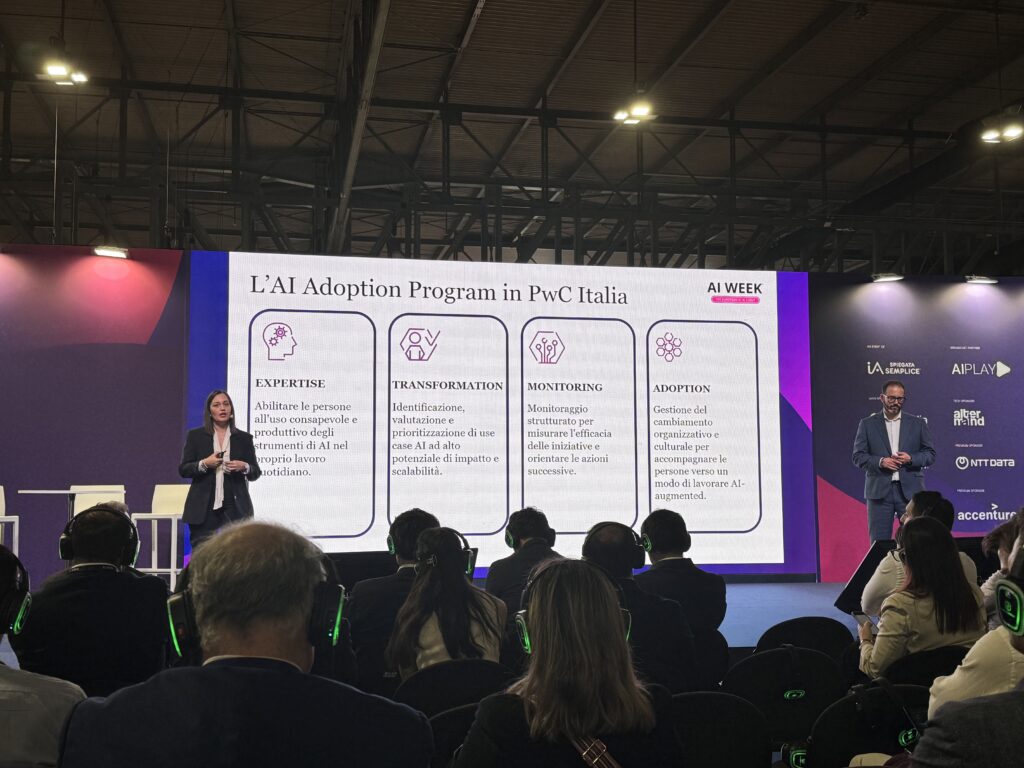
PwC Italy shared its internal AI adoption journey, explaining how the company invested heavily in internal training, educational workshops, AI literacy programs, practical demonstrations, structured use-case development.
What stood out was the emphasis on inclusivity. The program was designed not only for advanced users already experimenting with AI, but also for employees with little or no prior exposure to AI tools. This reflects a broader enterprise reality: Successful AI adoption depends not only on technology investments, but on creating organization-wide understanding and operational readiness.
As AI capabilities become more embedded into everyday workflows, workforce adaptability may become one of the most important competitive differentiators.
Infrastructure Is Becoming a Strategic Bottleneck
Another important discussion throughout the conference focused on infrastructure.
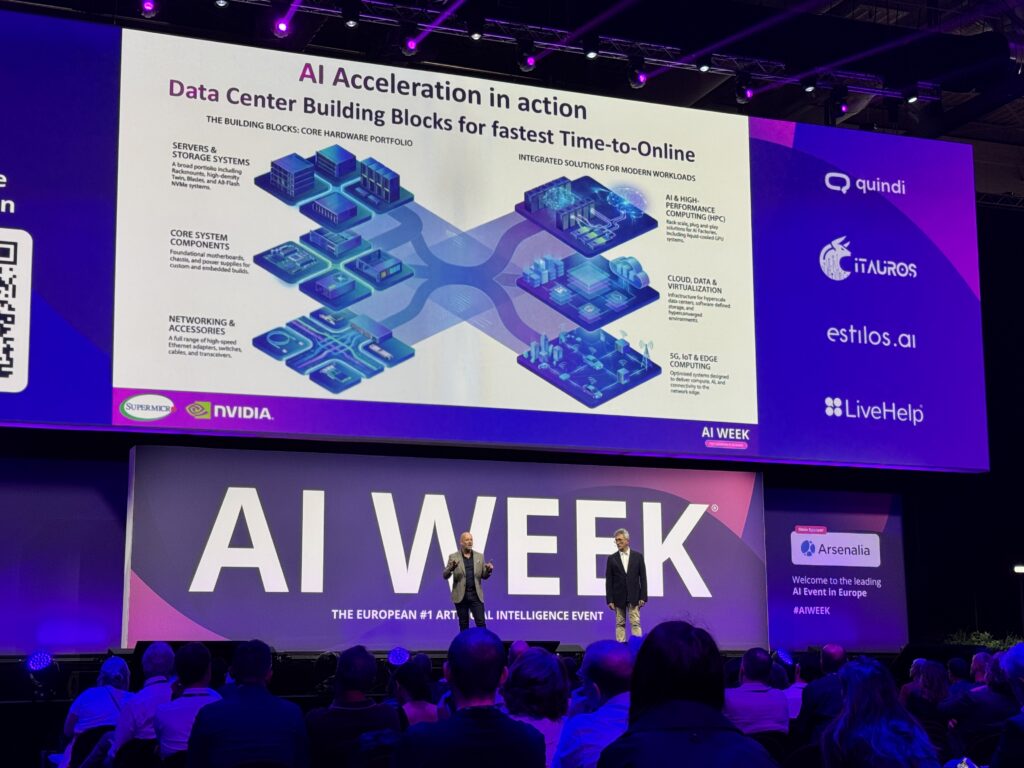
Sessions from companies such as NVIDIA and Supermicro highlighted that enterprise AI deployment ultimately depends on: compute power, semiconductors, data centers, networking, cooling systems, energy availability. In fact, the rapid growth of AI workloads is already reshaping demand for emerging specialties such as immersion cooling, as high-density compute environments require entirely new thermal management approaches.
One speaker described the current moment as an “AI rush,” comparing today’s infrastructure race to the gold rush of previous eras: the organizations building the infrastructure behind AI may become just as important as those building the applications themselves. This dynamic is already visible in energy markets, where AI-driven electricity demand is accelerating the development of the transformer oil market and reshaping grid modernization priorities.
This reinforces an increasingly important point: AI transformation is not only a software challenge. It is also an infrastructure challenge.
Perhaps the most important takeaway from AI Week Milan is that enterprise AI is becoming operational.
The future presented throughout the event was not centered around standalone chatbots or isolated productivity tools. Instead, organizations are moving toward orchestrated AI agents, vertical enterprise platforms, embedded operational intelligence, governed by automation systems, and semi-autonomous enterprise workflows.
For industrial and B2B organizations, the implications are significant.
The companies most likely to generate long-term value from AI will not necessarily be those deploying the largest number of tools, but those capable of combining trusted data, domain expertise, governance, infrastructure, and organizational readiness into scalable decision-making systems.
AI Week Milan demonstrated that enterprise AI is no longer approaching the operational core of the business. It is becoming part of it.
From AI Experimentation to Operational Advantage
AI Week Milan reinforced what Kline and Company is already seeing across industrial and B2B markets: AI is now part of core business workflows.
For Kline and Company, this means embedding AI into how we connect knowledge, normalize data, scale expertise, and deliver value to clients more efficiently. Through initiatives such as Charlie AI and workspace-enabled collaboration, we are already improving how clients access prior research, accelerate analysis, and engage with Kline and Company expertise across projects and regions.
Over the next 6–12 months, clients can expect faster insight delivery, more dynamic engagement models, and increasingly interactive, query-driven access to information and expertise.
Kline and Company’s differentiation is combining AI with deep sector expertise, proprietary knowledge, and expert-led workflows to deliver trusted, decision-grade insight at greater speed and scale.
As highlighted throughout the conference, “AI becomes strategic when it powers enterprise decisions.” That principle closely reflects Kline and Company’s approach to using AI to amplify expertise, improve consistency, and scale insight delivery responsibly.
Turn Data Into Faster, Smarter Decisions
Learn how Kline and Company applies AI, analytics, forecasting, and digital intelligence to help organizations identify opportunities faster and make more informed decisions.
Explore Kline Digital