
Dr Antonella Liselle
Project Manager, Food and Nutrition
Consumer demand shifts by the day nowadays. Agricultural supply, however, changes over seasons, years, or even decades. What do viral demand shocks mean for ingredient manufacturers?
FIG. 1 Two clocks: A trend reaches procurement in days; no supply lever responds in under a year
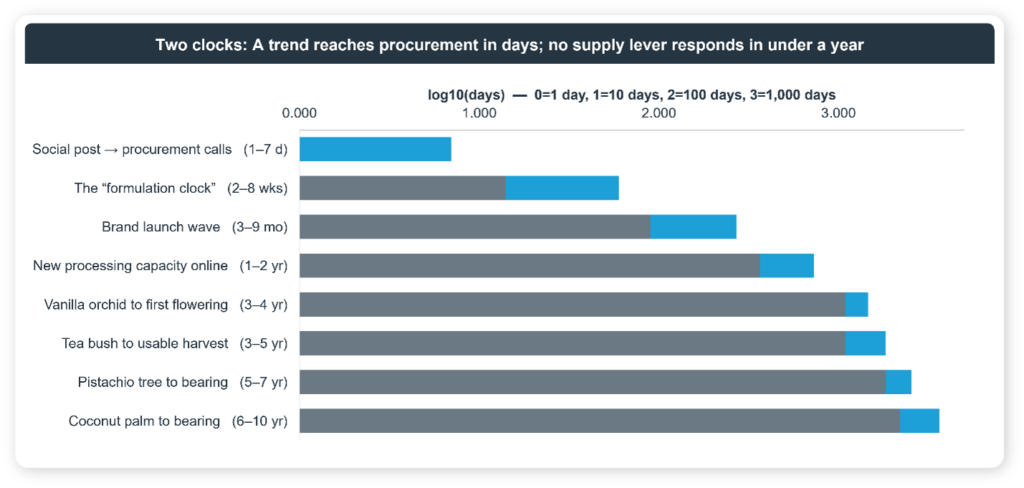
The core asymmetry, drawn to scale. The log axis heavily flatters the supply side: the distance from the first procurement call to a bearing pistachio tree is five to seven years. Every supply-side lever sits to the right of the line the trend has already crossed.
Demand-side durations are illustrative. Biological lead times are standard agronomic ranges.
Food trends have always influenced ingredient markets. What has changed is the speed, scale, and simultaneity of the demand signal. A compelling nutrition narrative, a visually distinctive product, or a single viral social media post can now push a niche ingredient into global procurement discussions within days. Agricultural supply chains, however, remain governed by biological lead times: pistachio trees take years to mature; coconut palms require long replanting cycles; vanilla depends on hand-pollination and curing; and Japanese tea fields cannot instantly convert into premium tencha production. This mismatch between “viral demand time” and “agricultural supply time” is becoming a structural risk for food ingredient manufacturers.
The most recent and visible example is the Dubai chocolate phenomenon, where a pistachio-filled chocolate bar moved from social media curiosity to being a global confectionery trend. The demand surge did not require a huge share of global pistachio production to create disruption; rather, it exposed a shortage in the specific form the market needed: kernels, paste, and cream, while much of the crop was committed to in-shell snacking channels. In 2025, reported pistachio prices rose from about $7.65/lb to $10.30/lb, and Iranian exports to the UAE increased sharply as the market redirected supply toward the trend. The military conflict involving Iran, which began in late February 2026, further disrupted shipping routes, choked off general export flows, and pushed remaining market prices to new multi-year highs.
FIG. 2 The Dubai chocolate move: A +34.6% price shift driven by form factor, not tonnage
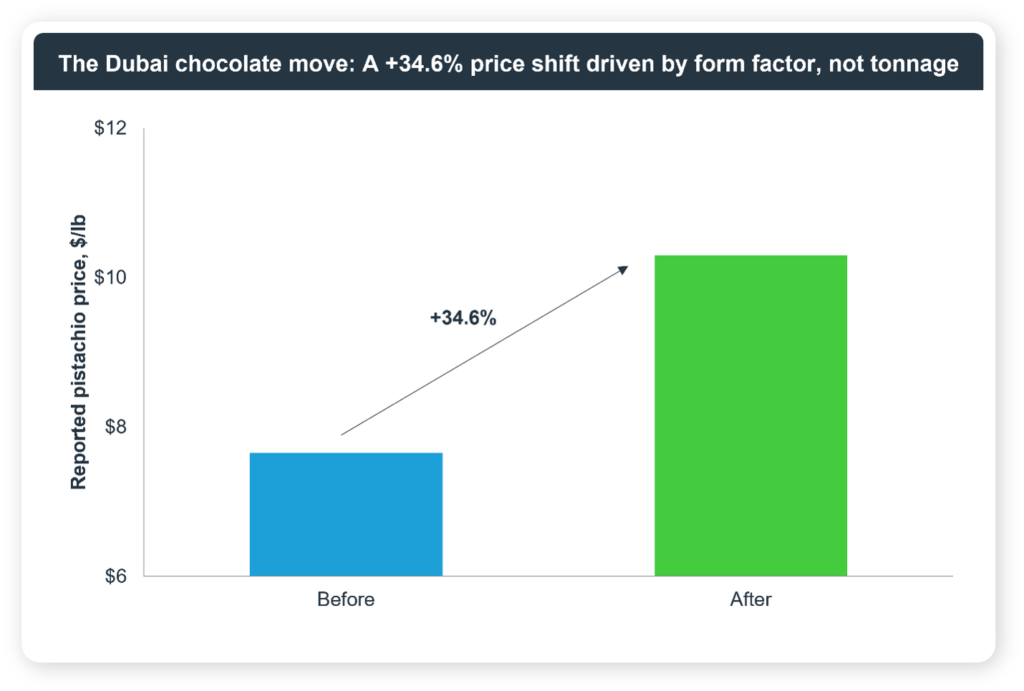
The constraint was the conversion step. Total crop tonnage was not the binding limit; the availability of kernels, paste and cream was. This is why value accrues to whoever controls shelling, milling, extraction, and grade segmentation rather than whoever sits closest to the farm.
Prices as reported as average, no volume breakdown.
This is the new mechanics of food ingredient disruption: not necessarily a true global shortage of the crop, but a shortage of the right form factor, in the right geography, at the right moment. For ingredient manufacturers, that distinction matters. The winners are not always those closest to the farm; they are often those controlling the conversion step: shelling, milling, extraction, paste production, grade segmentation, or application-ready formats.
The demand-shock lifecycle: From discovery to disruption
Across pistachio, matcha, vanilla, coconut, almond, oat, avocado, quinoa, and chia, a consistent lifecycle trend emerges. First, an ingredient is discovered or repositioned through a health, wellness, cultural, or aesthetic narrative. Then the story is amplified by media, influencers, chefs, cafés, or social platforms. Brand owners follow with a wave of launches, converting consumer excitement into a procurement event. Supply tightens, spot prices rise, buyers over-order, and the bullwhip effect amplifies a relatively modest end-market movement into a much larger upstream signal.
The second half of the cycle is often more damaging. Supply eventually responds through new plantings, new origins, expanded processing capacity, or alternative sourcing, but it frequently arrives after demand has normalized or shifted. This creates the classic boom-bust pattern: shortages and high margins at the peak, followed by oversupply, price collapse, underutilized assets, and in some cases permanent demand destruction through reformulation.
FIG. 3 The full cycle and what to sign at each stage
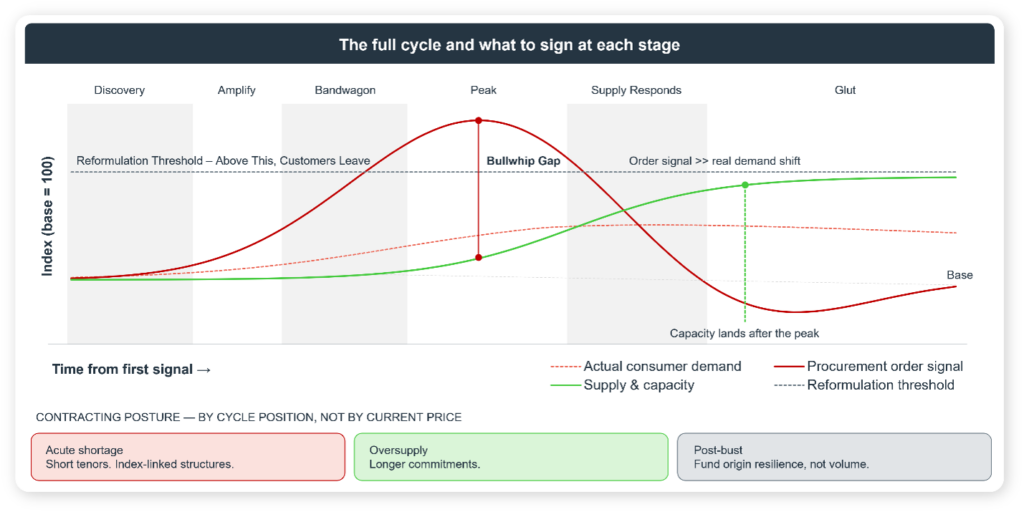
The shortage is not the risk, the cycle is. The gap between the two red lines is the bullwhip: a modest consumer shift, multiplied by everyone ordering defensively at once. The sage line, the only one representing real productive capacity, crosses upward just as demand rolls over. The amber line is the one to watch commercially: pass through a spike above it and the volume may never come back.
Schematic. Curve shapes illustrate the mechanism described in the article; they are not fitted to a specific commodity series.
Vanilla is the clearest example. The clean-label movement and concentration of supply in Madagascar pushed natural vanilla prices to extreme levels in 2017–18. But as prices rose, industrial users reformulated toward synthetic or nature-identical vanillin. Today, the market is dealing with oversupply: industry sources point to global vanilla supply well above demand, significant inventories, and sharply lower prices versus the peak.
Passing through a full price spike may protect short-term margin but can permanently shrink the addressable market.
For ingredient manufacturers, the lesson is uncomfortable but critical. Once customers reformulate successfully, the lost volume rarely returns simply because the original ingredient becomes cheaper again.
Not every trend disrupts the same part of the supply chain
A key strategic mistake is treating trend ingredients as simple commodities. In most cases, the shortage occurs in a specific node of the value chain. In pistachio, the constraint was not total crop tonnage but kernels and paste. In oat milk, the issue was not only oat acreage but processing capacity. In matcha, the pressure is strongest in Japanese tencha and premium grades, not necessarily all powdered green tea formats. In coconut, competition for whole nuts and coconut oil has intensified because food, beverage, oleochemical, and biodiesel use are now competing for overlapping supply pools.
Matcha illustrates how nuanced the supply response can be. Japan’s green tea exports rose strongly in 2024, supported by global demand for matcha and powdered tea, while tencha production has also increased over the past decade as farmers converted from other tea types. However, heat stress in Kyoto, limited producer succession, milling constraints, and the premium-grade nature of ceremonial matcha mean that not all supply can scale equally.
Coconut represents a different pattern: a slower moving but structurally constrained market. The Philippines moved to a 3% coco-methyl ester biodiesel mandate in October 2024, with planned increases later suspended amid concerns about coconut oil prices and supply. This shows how policy demand can directly compete with food and ingredient demand, adding another layer of volatility for manufacturers using coconut oil, coconut cream, and other derivatives.
The five preconditions for a food ingredient demand shock
Kline’s review of recent ingredient disruptions points to five recurring preconditions. When four or more are present, the ingredient should be treated as a live watch-list risk.
The bullwhip effect is central. A trend does not need to consume a major share of global production to disrupt the market. If retailers, brands, distributors, and processors all over-order simultaneously to avoid being short, the upstream signal can become several times larger than the true consumer demand shift. This is why the Dubai chocolate case was so disruptive despite the relatively modest volume of pistachio cream directly required.
The boom-bust trap: When capacity arrives after the trend
Ingredient manufacturers face a particular risk that brand owners often avoid stranded capacity. Oat milk shows how quickly a processing bottleneck can become an overcapacity concern. During the growth phase, oat milk demand exceeded available processing and brand capacity. Then drought hit North American oat supply in 2021, with U.S. oat production falling to a record-low 39.8 million bushels, down 39% from 2020. But as the category matured and sales growth slowed, dedicated capacity became harder to justify.
Almonds show a related reversal. Once framed primarily as a scarcity and water-risk category, California almonds are now closer to a buyer’s market. USDA-NASS estimated the 2025 California almond crop at 3.0 billion meat pounds, 10% above the prior year and potentially the second largest on record. For processors with almond-specific assets, the strategic question has shifted from “how do we secure supply?” to “how do we defend utilization and margins in a mature plant-based category?”
Quinoa is the classic boom-bust case. FAO-linked analysis shows prices rose sharply between 2008 and 2014, approximately 305% in Bolivia and 407% in Peru, before the market corrected as production expanded and new suppliers entered. The result was not only lower prices but also origin stress, including soil degradation and pressure on smallholder systems.
What this means for food ingredient manufacturers
For ingredient manufacturers, viral demand shocks should not be treated only as procurement problems. They are also commercial strategy events. The companies best positioned to win are those that identify early signals, understand which form factor is likely to be constrained, and move quickly with specifications, samples, application support, and alternative-origin options.
1. Build trend intelligence into commercial strategy, not only procurement
Social listening, chef and menu tracking, retail launch monitoring, and customer briefs should feed both sourcing and sales teams. The critical window is the “formulation clock” the weeks when brand owners move from noticing a trend to developing a product.
2. Compete on conversion capability
In many categories, value accrues to the manufacturer that can deliver the right usable format: pistachio paste, coconut cream, vanilla extract, matcha grades, oat bases, chia blends, or application-ready inclusions. Owning or controlling conversion capacity is more defensible than simply holding raw commodity volume.
3. Manage substitution risk deliberately
Every spike has a threshold at which customers begin reformulating. Know that threshold by application and customer segment, and consider partial absorption, blended systems, lower-inclusion solutions, or portfolio substitution before customers leave the ingredient entirely.
4. Apply a pre-trend return test to capex
If a new asset only earns its return at peak-trend volumes and peak-trend margins, it is not a capacity investment, it is a bet on trend persistence. Flexible, multi-substrate, tolling, or brownfield options are often better risk-adjusted structures than dedicated greenfield capacity.
5. Pre-qualify alternative origins before disruption
Qualification cycles can take months, while viral demand shocks can peak in weeks. Chia demonstrates this clearly: Paraguay’s export growth, weather risk, and frost exposure have made alternative origins and forward contracting increasingly important.
6. Contract according to cycle position, not current price
Acute shortage categories call for short tenors and index-linked structures; oversupplied categories may justify longer commitments at attractive pricing; post-bust categories require investment in origin resilience rather than volume-chasing.
7. Treat traceability and Environmental, Social, and Governance (ESG) resilience as commercial levers
Avocado and quinoa show that reputational, environmental, and social issues can become supply constraints. For ingredient manufacturers selling into major food brands and retailers, traceability is increasingly a condition of access, not a “nice to have.”
KLINES VIEW
The demand shock is not the risk, the cycle is
The main risk for ingredient manufacturers is not the initial shortage. Shortage can create margin, pricing power, and customer urgency. The bigger risk is the full cycle: inflated procurement, overbuilt capacity, reformulation by customers, delayed supply responses, and eventual price collapse.
The profit pool at the top of the cycle is often short-lived; the loss pool after the cycle can last years.
This changes how ingredient manufacturers should think about resilience. The objective is not simply to “secure supply.” It is to earn returns across shortage and glut. That requires a different capability set: Early trend detection, form-factor control, substitution-boundary management, alternative-origin qualification, and disciplined capex governance.
The next disruptive food trend is unlikely to announce itself through a formal forecast. It may begin as a café menu item, a TikTok recipe, a wellness claim, or a visually distinctive product that consumers replicate at scale. Ingredient manufacturers that monitor these signals early, and translate them into commercial and technical action, will be better positioned not only to manage disruption, but to capture value from it.