
Decades of rapid expansion, China’s professional beauty industry is entering a new phase, defined less by explosive growth and more by intensifying competition, channel disruption, and rising consumer expectations around performance and proof.
At China Beauty Expo (CBE), Carol Du, Consultant of Kline + Company’s Beauty and Wellbeing vertical, will explore what this shift means for brands across both professional skin care and professional hair care, and where the next wave of opportunity lies. Below is a preview of some of the key dynamics that are shaping the market today:
Professional Skin Care Market in China
Growth Slows as the Market Matures
China’s professional skin care market reached approximately USD 4.3 billion in 2025, having grown at a double-digit compound annual rate (CAGR) since 2020, according to Kline’s Professional Skin Care Global Series analysis. However, that momentum has slowed considerably. Year-over-year growth dropped to just over 1% in 2025.
The market is forecast to continue expanding at a modest pace through 2030, signaling a shift from rapid volume growth to a more mature, value-driven competitive environment where clinical efficacy and scientific credibility are becoming the primary differentiators.
The competitive landscape also continues to evolve with new entrants backed by established industry players, including ALASTIN Skincare from Galderma, RQ PYOLOGY from Shiseido, and Clinique CX from The Estée Lauder Companies.
Consumer Shift Toward Medical Aesthetic Treatments
Medical care providers represent a small but significant share of the market. As consumers increasingly seek more visibly effective medical aesthetic treatments, med-spas continue to gain traction, while medical outlets broaden their offerings to include basic skin care services and spa brands expand further into the medical aesthetics channel.
Although the broader market remains dominated by local players, international brands such as SkinCeuticals and Fillmed continue to hold strong positions within the medical aesthetics channel.
Retail remains the dominant channel, accounting for approximately two-thirds of total market sales, with platforms such as Tmall, JD, and Douyin driving the majority of revenue. However, online growth is showing early signs of saturation as these platforms mature.
Beauty institutes and spas account for about one-fifth of the market but continue to contract year over year, pressured by premium retail brands such as La Mer and La Prairie, which opened spa rooms within their brand counters.
.
Regulation and the Rise of Evidence-Based Beauty
Specialty treatments and serums are the leading product category, followed by moisturizers and cleansers. On the demand side, anti-aging is the primary skin concern driving purchases, ahead of dehydration and hyperpigmentation.
The market is now entering a more proof-driven phase. Device-led treatments such as HydraFacial and photo rejuvenation are increasing demand for complementary products, while expansion into lower-tier cities is opening new growth corridors. At the same time, regulatory tightening by the NMPA, including a broad set of reform measures announced in late 2025, is limiting outlet expansion but helping to professionalize the industry.
Professional Hair Care Market in China
Rational Shoppers, Smarter Channels Diversification
China’s professional hair care market in 2025 was almost flat as in 2024 (+0.3%) but became more balanced and resilient, finds Kline’s Professional Hair Care Global Series analysis. The recovery of offline consumption, supported by government policies, helped salon visits rebound in the second half of the year. As a result, the decline in salon sales narrowed, while e-commerce remained the main growth engine and brick-and-mortar retail continued to expand from a small base.
The salon channel is still under pressure, but the pace of closures slowed. Moreover, several leading players improved their performance. Meanwhile, more brands expanded in offline retail to reduce dependence on salons and pure-play e-commerce, moving further into supermarkets and hypermarkets. Some players faced temporary supply issues, leading to short-term exits and re-entries in certain warehouse-club formats.
Treatment Growth Offsets the Decline in Hair Color
Hair care overall returned to low- to mid-single-digit growth, driven by strong demand for premium treatment products. Hair color, while still declining, showed a slower rate of contraction compared to previous years. Hair texturizing remained weak overall, while hair styling and sprays improved compared to 2024.
This reflects a broader move toward treatment-led routines, echoing trends seen in professional skin care.
From Promotion to Product Performance Focus
Consumer behavior also evolved. Shoppers became more rational and demanding, focusing less on constant promotions and more on efficacy, value for money, and personal fit. Demand in hair color shifted toward more personalized, “natural yet elevated” looks, with softer, lower-saturation shades. In care, consumers increasingly favored high-performance treatments such as hair masks over traditional conditioners. Scalp care, nourishment, and shine were key innovation themes, with many new launches being centered on scalp oil control, vitality, anti-hair-loss, deep repair, and a smoother, more refined finish.
For a deeper dive into these dynamics, join our presentation at China Beauty Expo, which will answer key questions such as:
- Where are the real growth opportunities in the professional skin care and the professional hair care market?
- How should channel strategy evolve as boundaries blur?
- What does “winning” look like in an evidence-driven, performance-first landscape?
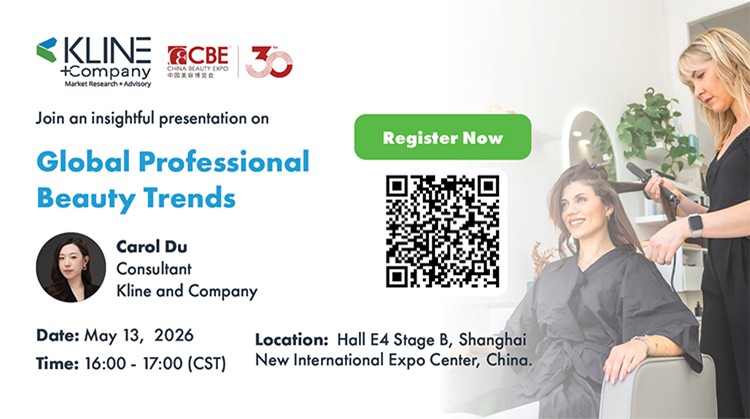
Meet our experts Carrie Mellage, Vice President and Carol Du, Consultant, at the event to discuss how Kline + Company can help you assess opportunities, refine strategy, and unlock value in the evolving professional beauty market.
Beyond market intelligence, Kline supports beauty companies and investors with growth strategy advisory services, including M&A, covering target screening, commercial due diligence, and post-acquisition value-creation.