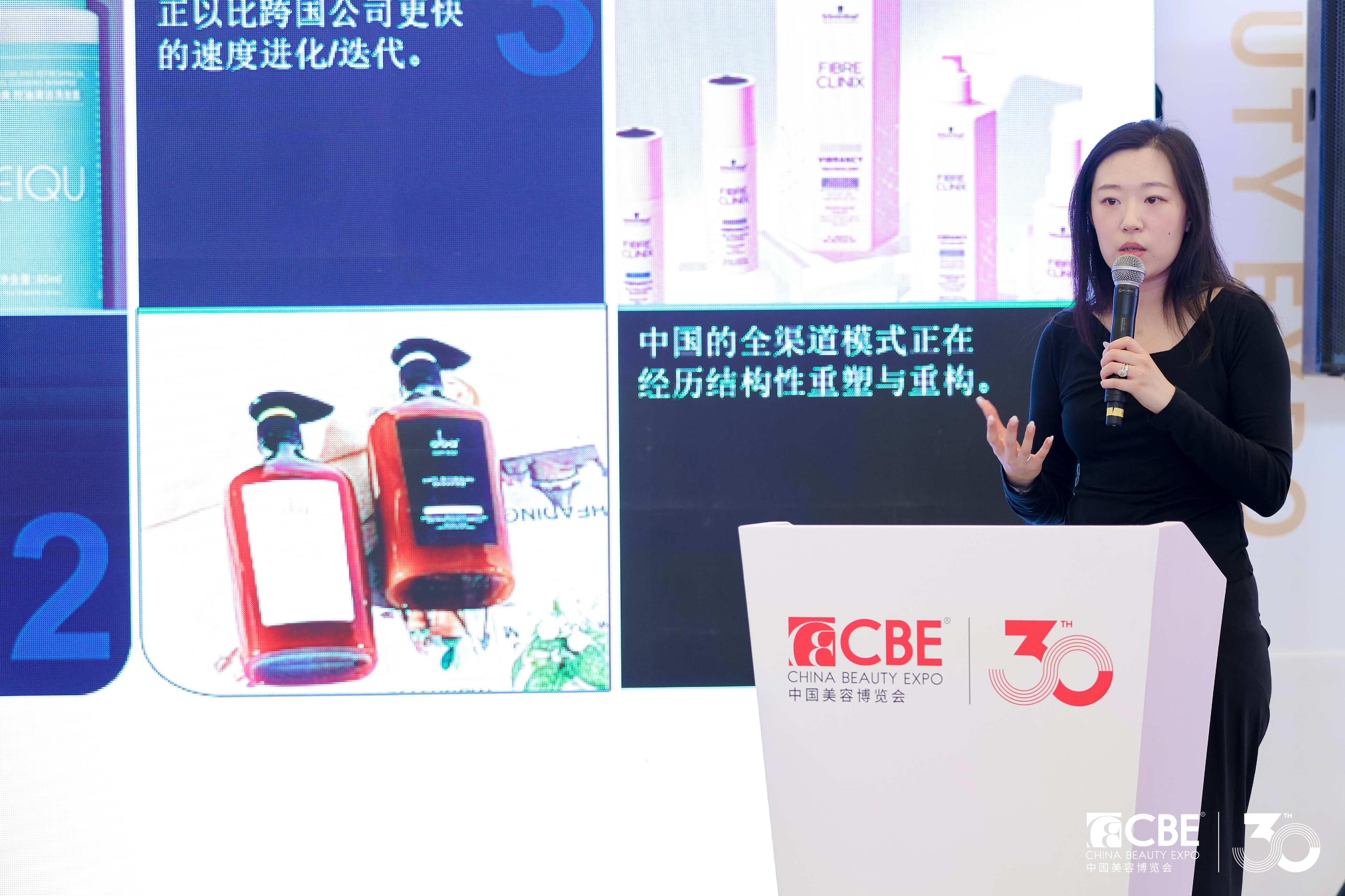
Built on Kline’s recent blog on China’s professional beauty market highlighting the growing role of science, sustainability, and localized innovation, additional signals from the China Beauty Expo (CBE) 2026 show floor emphasized how these shifts have translated into brand strategy and market execution. Across both domestic and international exhibitors, four themes have emerged at this year’s event, according to Carol Du, Consultant in Kline + Company’s Beauty and Wellbeing vertical:
1. Longevity Gains Momentum in China
At CBE 2026, longevity was increasingly defined by a shift from traditional anti – aging methods toward cellular-level intervention, moving beyond wrinkle reduction to target biological age at the mitochondrial and genetic level.
We saw this with Proya, whose founder, Hou Juncheng, highlighted “holistic beauty and health” in his keynote, signaling that longevity could become its next major strategic focus. Proya has already taken several steps in this direction, including partnering with West China Hospital on mitochondrial anti-aging initiatives.
Several other domestic Chinese beauty brands reinforced the longevity trend, including:
- CHANDO showcased its seventh-generation Purple Bottle, targeting “fatigue-induced aging” through mitochondrial energy reactivation.
- BIOHEAL BOH (百析珀) presented a NAD+ line centered on activating the SIRT3 longevity gene.
- Dr. Alva (瑷尔博士) launched a royal jelly acid mask claiming activation of six SIRT longevity proteins and a 27+% increase in telomere length.
- Attenir (艾天然) centered its booth around SIRT6 activation through its proprietary “S6 Reversing Factor.”
- FineNutri (斐萃) focused on oral longevity with NAD+ supplements.
2. Biotech Ingredients Remain a Hotspot in China
Another observation at CBE 2026 was the growing focus on cell-level technologies, reflecting the dual pursuit of “verifiable efficacy” and “delivery efficiency” at the cellular level. Examples include:
- BIOHYALUX (润百颜) highlighted its ECM (extracellular matrix) technology strategy, positioning itself as an “ECM tech skin care leader” and launching the White Gauze Ampoule 4.0, featuring ECM system repair designed to optimize the cellular environment at the source.
- Forest Cabin (林清轩) introduced a whitening oil featuring “Camellia Phagocytosis 677,” a patented ingredient positioned around “cell-level whitening” through melanin inhibition at the cellular source.
- Proya (珀莱雅) reinforced its focus on cellular anti-aging with the new Ruby Micro-Bead Essence (红宝石微珠精华), targeting four major aging signs using proprietary Dual-Cyclic Peptide, 3D Collagen, and PDRN.
- Dr. Ling (凌博士) highlighted its legacy as the first company to extract hyaluronic acid from cow eyes in 1983, alongside its full-molecular-weight HA technology.
3. Retail and Professional Channel Convergence Accelerates in China
The boundaries between cosmetic specialty stores, supermarkets, pharmacies, salons, beauty centers, and medical aesthetics institutions are rapidly dissolving as brands expand across multiple consumer touchpoints. This was observed at CBE 2026, which included two dedicated professional beauty halls integrating medical aesthetics, skin management, and salon products under one roof.
Pharmacy-driven brands such as Voolga (敷尔佳) and Juyou (绽妍), traditionally found in drug stores and hospitals for post-procedure recovery, were actively exhibiting alongside salon-focused brands within the professional beauty halls.
Brands originally rooted in retail channels, including BIOHYALUX (润百颜), the beauty brand under Bloomage Biotech (华熙生物), and Winona (薇诺娜), appeared across multiple channel touchpoints, signaling expansion into medical aesthetics and professional skin management.
Meanwhile, companies such as Kerton Laser (科顿激光), DJM, and Meice (美测) highlighted the growing role of medical devices and AI diagnostics in bridging beauty tech with clinical settings.
The message across the show floor was clear:
“Consumers increasingly expect to find professional-grade, functional products wherever they shop, while channels that once operated independently are now beginning to compete and collaborate within the same ecosystem,” says Carol Du, Consultant, Kline’s Beauty and Wellbeing vertical.
This trend aligns closely with findings from Kline’s Professional Skin Care China analysis, which highlighted the ongoing multi-channel merging trend. Kline’s 2026 outlook shows that medical care providers, beauty institutes, and spas may gradually decline as primary sales channels, while retail continues to gain share. However, these professional channels are likely to take on a more strategic marketing role, serving as trust-building touchpoints, experiential showrooms, and consumer education hubs.
Forecast Manufacturers’ Sales of Professional Skin Care Products in China by Channel and Segment
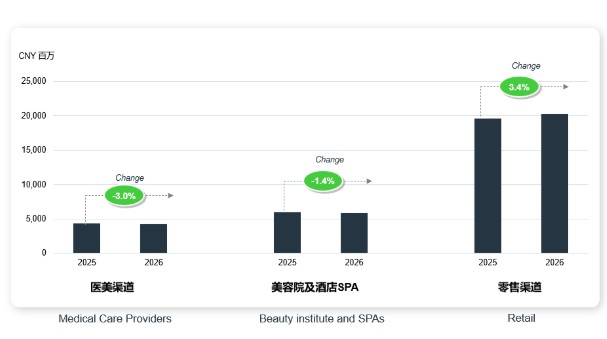
Source: Kline’s Professional Skin Care China analysis
4. Beauty Brands in China Push for Global Expansions
Many domestic brands are increasingly viewing Southeast Asia as their first stop for global expansion, driven by geographical proximity, cultural similarities, and relatively lower market entry barriers.
Proya (珀莱雅), for example, has been actively expanding across Southeast Asia. In May 2026, the brand held a “No Skin Drama, Just PROYA” event at the flagship store of Malaysia’s Guardian, the country’s largest health and beauty retailer, reportedly becoming the Chinese beauty brand with the highest single-day product sales in the store’s history. Proya has since launched its core product lines, including the Source Power, Ruby, and Double Anti series, across more than 200 Guardian stores in Malaysia, marking a significant milestone in its regional offline expansion.
Other brands observed at CBE 2026 pursuing international growth strategies included CHANDO (自然堂), Winona (薇诺娜), and BIOHYALUX (润百颜), all of which have been actively exploring Southeast Asian markets through distribution partnerships and localized marketing efforts.
Meanwhile, Europe and the United States continue to hold the greatest potential for explosive growth. Despite growing international ambitions, relatively few domestic Chinese brands have meaningfully penetrated mainstream Western markets, largely due to challenges around regulatory requirements, channel development, and consumer awareness. However, Western consumers’ interest in Eastern aesthetics, botanical traditions, and wellness philosophies remains strong, creating an opportunity for culturally rooted Chinese brands to differentiate themselves globally.
Want to Learn More?
Explore more insights shared by Kline during CBE 2026, including key trends shaping the global professional beauty market, evolving channel dynamics, and emerging growth opportunities across professional skin care, professional hair care, and medical aesthetics.
Download The PresentationLet's Connect