The aesthetic consumer of today is facing more choices and more competing priorities than ever before.
While professional skin care and aesthetic treatments remain important investments, new spending demands are forcing consumers to make increasingly deliberate decisions about where their beauty dollars go. The result is not necessarily reduced engagement with aesthetics, but rather a reallocation of spending across a broader ecosystem of health, wellness, skin care, treatments, and cosmetic surgery.
Financial Pressures Are Reshaping Aesthetic Consumer Spending
Kline + Company’s 2026 Aesthetic Skin Care Consumer Insights survey found that financial pressures are now among the most influential factors shaping the future skin care spending. Household expenses, disposable income, and debt management are increasingly affecting purchasing decisions, while consumers simultaneously balance investments in aesthetic treatments, professional skin care, weight management, and long-term wellness goals.
How GLP-1 Medications Are Redirecting Beauty Budgets
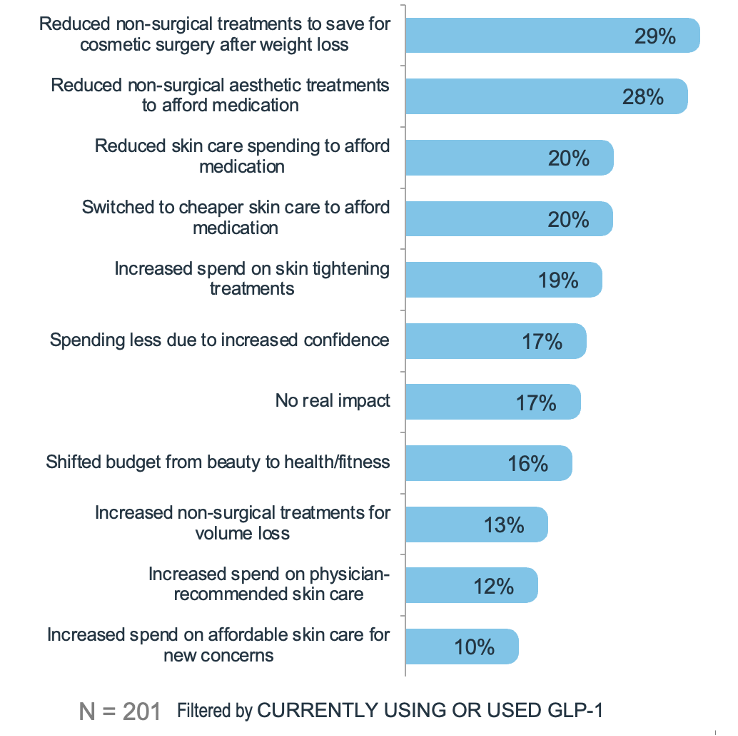
Perhaps, no trend illustrates this shift more clearly than the rise of GLP-1 medications. More than one-third (34%) of aesthetic consumers report currently using GLP-1 medications. Among those users, 29% have reduced non-surgical treatments to save for cosmetic surgery after weight loss, 28% have reduced non-surgical aesthetic treatments to afford the medication, while 20% have reduced skin care spending and switched to less expensive skin care alternatives. Yet the impact is not entirely negative for the aesthetics market.
As rapid weight loss creates concerns around facial volume loss, skin laxity, and overall skin quality, many consumers are redirecting spending toward corrective solutions. Nineteen percent of GLP-1 users have increased spending on skin-tightening procedures, while 13% report increasing spending on treatments designed to address volume loss.
GLP-1 Impact on Beauty and Aesthetic Treatment Spending
Source: Kline + Company’s 2026 Aesthetic Skin Care Consumer Insights
The survey also found that 42% of aesthetic consumers have either undergone cosmetic surgery recently or are planning one in the future, further highlighting how spending is shifting across adjacent categories rather than disappearing altogether.
Professional Skin Care Continues to Deliver Value
Professional skin care continues to play an important role within this evolving landscape. Despite competing financial priorities and investments in health/weight loss management, 87% of consumers say that they are willing to pay more for clinically proven results, and nearly half have increased the use of professional skin care products within their routines. Consumers are becoming increasingly selective, prioritizing products and treatments that deliver measurable outcomes while evaluating where they can reduce spending elsewhere.
For brands, providers, and aesthetic practices, understanding these evolving trade-offs will be critical as consumers continue to rebalance their beauty budgets. As Kline + Company prepares to launch the next wave of its Physician Dispensed Skin Care: U.S. Perception and Satisfaction Survey, the focus will shift to the provider perspective. The upcoming research will explore how physicians are adapting to these changing consumer priorities; the impact of GLP-1 adoption on demand for procedures such as skin tightening and dermal fillers; and what support, incentives, and partnership strategies are most effective in helping practices keep patients engaged with professional skin care both in office and at home.