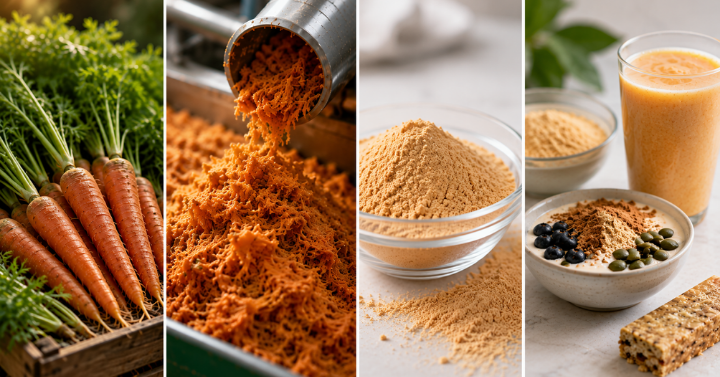
Upcycling has quietly outgrown its sustainability origins. For a growing number of ingredient suppliers, recovering value from byproducts and sidestreams is no longer a corporate-responsibility line item; it is rather a route to new revenue, better margins, and differentiated products.
The market is signaling as much. In June 2026, Ingredion acquired Benicaros, a clinically backed prebiotic fiber made from upcycled carrot pomace, which is the fibrous leftover from carrot juice production. When a major global supplier acquires an upcycled ingredient along with its intellectual property, clinical data, and manufacturing know-how, the message is clear: a well-developed sidestream can be a premium, differentiated ingredient, not a disposal problem.
This article focuses on where that shift creates commercial value: business-to-business food ingredients and nutrition applications for human consumption, where upcycling delivers nutrition, supply-chain resilience, and a reason for customers to pay more.
1. Why the Opportunity Is Real: From Waste Reduction to Strategic Imperative
The scale of inefficiency in the food system is the starting point. The FAO estimates that roughly one-third of all food produced for human consumption, about 1.3 billion tonnes a year, is lost or wasted, at an economic cost approaching USD 1 trillion. UN Environment Programme and IPCC figures attribute an estimated 8–10% of global greenhouse gas emissions to food loss and waste, and the UN’s Sustainable Development Goal 12.3 calls for halving per-capita food waste by 2030.
The commercial point hides inside those numbers. Most food waste still flows into low-value endpoints such as animal feed, compost, bioenergy, and landfill, which means fiber, protein, and bioactive compounds are being stripped out of the human food chain even when they remain perfectly intact and saleable. That gap is the value pool.
2. Where Upcycling Adds Value, and Earns a Premium
Not every byproduct belongs in a food product, and credibility depends on stating so. However, materials such as fruit pomace, cereal residues, oilseed meals, and vegetable sidestreams can be consistently nutritionally meaningful when handled well.
What has widened the opportunity is processing, not the rediscovery of waste. Fermentation, enzymatic treatment, and controlled drying now allow these materials to be stabilized, standardized, and sold as functional ingredients with predictable performance. Brewers‘ spent grain is a clear example. Historically treated as low-value animal feed, it is now the feedstock for a cohort of specialist suppliers: Switzerland’s UpGrain, Germany’s ValueGrain, and Canada’s Terra Bioindustries. The processing routes differ.
UpGrain uses mechanical separation and drying to split spent grain into protein barley powder and fibre concentrate, and a flour substitute. Terra Bioindustries applies a low-energy enzymatic process that fractionates the same material into separate protein, fibre, sugar, and flavour streams. ValueGrain installs patented low-tech equipment directly in breweries, which removes the need to transport a wet, perishable feedstock. In each case, capturing that value took years of process development, and the resulting ingredients now compete on nutritional density, cost, and clean-label positioning, not only on their sustainability story.
That is the pattern worth underlining. Upcycling commands a premium, and scales, when it delivers:
- Functional benefits, such as fiber enrichment, complementary protein, and prebiotic activity
- Demonstrable nutrition, backed by data rather than sustainability claims
- Reliable formulation performance at commercial scale, not just in pilots
Upcycled ingredient suppliers need to pair a credible nutrition story with formulation advantages (e.g. a workable inclusion rate, acceptable flavour, and substitution into existing recipes without radical reformulation) that give formulators a reason to choose them regardless of the circular-economy angle.
That distinction is decisive in markets where nutrition or cost, not sustainability, triggers purchase. It also explains why third-party credentials such as Upcycled Certified, which require verifiable supply chains and minimum upcycled content, matter: they turn a soft claim into something a customer can underwrite.
3. Why Scaling Remains Uneven
If the reason is compelling, adoption is still gradual for practical reasons. Sidestreams are inherently variable; their composition shifts with season, geography, and upstream processing, complicating standardization. Qualification can be slow, as waste-derived inputs often need extra safety, allergen, and stability testing.
Moreover, cost remains a constraint, particularly across parts of Asia-Pacific, where higher processing costs, limited scale, and uneven demand leave upcycled ingredients struggling to compete with conventional alternatives.
4. Incremental Integration, Not Disruption
One pattern is clear: upcycling scales most effectively when it is incremental. Rather than replacing conventional ingredients outright, recovered materials are easiest to deploy when they enhance existing formulations. Common, lower-risk approaches include:
- Boosting fiber content using fruit or grain sidestreams
- Complementing protein blends with recovery-based inputs
- Improving resource efficiency without altering consumer experience .
This model reduces technical risk while still delivering measurable gains, and it aligns with how food innovation typically scales in practice, particularly where familiarity, affordability, and operational simplicity carry weight.
5. From Sustainability Narrative to Strategic Capability
As the field matures, the question is no longer why upcycle, but where value is being left on the table. A few realities define who captures it:
- Byproducts demand commercial discipline. Streams that look attractive on paper still need consistent quality, sufficient volume, and workable economics to justify investment.
- Not all valorization belongs in-house. Selling residues to specialized processors sometimes beats internal development on return.
- Imperfect raw materials are underused. Off-spec but nutritionally intact inputs are a low-complexity entry point, especially within processing rather than branded products.
- Design choices shape future optionality. R&D and process-design decisions determine whether byproducts become liabilities or assets.
Treated this way, upcycling becomes a capability built into how a business operates and a genuine contributor to top-line growth rather than a sustainability add-on.
Looking Ahead
The next phase of upcycling will be defined by execution, including identifying viable value pools, pressure-testing the economics, and embedding circular thinking into ingredient, formulation, and sourcing decisions. The suppliers that treat upcycling as a commercial capability, rather than a sustainability gesture, are the ones positioned to capture the margin.
Kline’s Food & Nutrition team has advised ingredient companies on value-added upcycling strategy, including how to identify which sidestreams can become differentiated, revenue-generating ingredients, and what is required to commercialize them.
To explore how upcycling could strengthen your ingredient or nutrition strategy, contact Kline’s Food & Nutrition team.