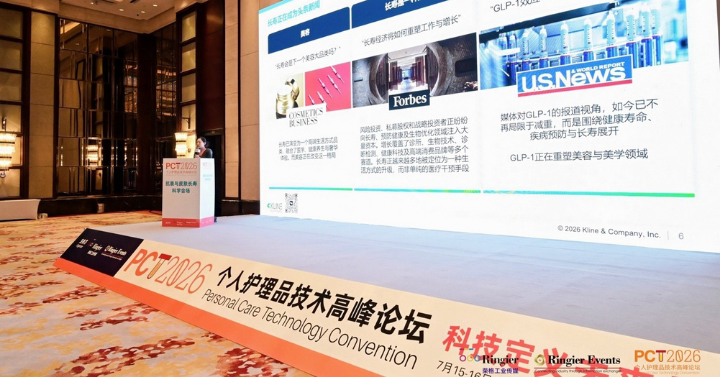
Earlier this month, Carol Du, Consultant, Beauty & Wellbeing, China, at Kline + Company, took the stage at Ringier’s Personal Care Technology Convention (PCT) 2026 in Shanghai to discuss how longevity is reshaping the future of beauty. Across the conference, four themes consistently emerged, each with direct implications for where beauty innovation, investment, and consumer demand are heading next. Here are Du’s key takeaways from the event:
- Longevity Trend Is Redefining the Underlying Logic of the Beauty Industry
Anti-aging research is no longer limited to superficial indicators such as wrinkles and sagging; it has expanded into deeper mechanisms such as extracellular matrix regeneration, longevity proteins, and stress-induced skin aging.
What was particularly striking was that this trend has already translated into concrete brand actions:
- Pechoin, jointly with Beijing Technology and Business University, released the 2026 East Asian Women’s Holistic Anti-Aging White Paper at the conference and introduced its “anti-cortisol” skin care concept. Targeting cortisol-induced skin aging, the brand screened approximately 300 candidate botanical species and selected Schisandra chinensisand Campsis grandiflora to develop its Anti-Cortisol Complex.
- Estée Lauder is focusing on extracellular matrix regeneration, advancing its serum products through a recombinant PDRN ingredient matrix.
These brand initiatives validate one of the key points of Carol’s presentation: Longevity is moving decisively from concept to commercial product development.
- Delivery System Upgrades Are Becoming a Core Lever for Brands to Break Through “Ingredient Saturation”
Across multiple forums at the conference, delivery system innovation was one of the most frequently discussed technological trends. “My observation is that as the ‘ingredient-conscious’ consumer base matures, competing solely on ingredient purity or concentration is no longer a sustainable differentiator,” says Du. Delivery efficiency is emerging as the new frontier in brands’ technological storytelling. For instance:
- Proya shared its Hyper3DS multi-layer delivery technology, which addresses the coexistence of sensitivity and anti-aging needs through skin typing and layered delivery.
- Yatsen Group’s brand DR.WU demonstrated its “Triple-Action Renewal” framework, integrating delivery logic into product experience design.
Together, these examples signal a broader shift in competitive advantage, from simply highlighting ingredients to demonstrating how effectively they are delivered.
- Cell Technology and Repair/Anti-Inflammatory Mechanisms Are Forming the Scientific Foundation for Efficacy-Driven Beauty Brands
The integrated model of oral and topical beauty products continued to gain momentum at this year’s conference.
- Inoherb’s collaborative model with Longhua Hospital, affiliated with Shanghai University of Traditional Chinese Medicine attracted significant attention. By taking clinical skin concerns as the starting point for product development, the brand has successfully bridged the gap from “medical prescription” to “cosmetic formulation,” significantly enhancing its credibility in the precision repair segment.
- Meanwhile, L’Oréal introduced AI-powered quantification tools in male skin research. Its skin aging atlas covers over 300 reference charts and has been applied to more than 500,000 subjects globally, with AI auto-rating accuracy exceeding 94%, providing large-scale data support for cellular-level skin research.
These developments underscore the growing importance of scientific credibility, with brands increasingly expected to build robust evidence at the cellular level.
- The “Oral and Topical” Synergy Model Is Accelerating, With Inside-Out Solutions Moving Toward Industrialization
The integrated model of oral and topical beauty products continued to gain momentum at this year’s conference.
- Pechoin has established supply chain partnerships with plant cell bio-manufacturing platforms such as PuRuiKang. Its Tremella fuciformisculture is the first botanical cell-based ingredient in China to complete the regulatory framework for both cosmetic and food use, providing a compliant template for developing “inside-out” product solutions.
- Brands such as Guyu are also actively exploring oral and topical product combinations, reinforcing their position as the providers of holistic beauty solutions.
As beauty increasingly intersects with health and wellness, competition will extend beyond topical skin care to more holistic, inside-out approaches that support consumers throughout their longevity journey.
PCT 2026 demonstrated just how quickly longevity is moving from scientific discussion to commercial reality. Across every stage of the innovation pipeline, from ingredient delivery and cellular science to integrated inside-out solutions, the industry is shifting its focus toward helping consumers maintain healthier skin for longer, rather than simply correcting visible signs of aging.
To learn how Kline helps beauty companies navigate growth and market change, explore our Business Strategy advisory services.