

Dr. Elizabeth Thundow
Vice President, Food and Nutrition
Capsules, tablets and powders have long dominated supplement formats. But the range of options available to brands is expanding.
Supplement brands have more ways to build a product proposition around how consumers take an ingredient, alongside the benefits it offers. Format, flavour, texture and portability all shape the experience, creating different routes to differentiation.
For ingredient suppliers and manufacturers, this opens up opportunities across product development and portfolio strategy. It also raises a practical question: where does a different format create enough consumer value to justify the formulation and commercial investment?
Format Becomes Part of the Proposition
Traditional capsules and powders remain established delivery methods, but emerging formats are giving brands new ways to package, position and differentiate their products.
Australian brand BODIE’Z‘s Creatine Fizz and Electrolyte Fizz sachets, launched in September 2026, combine functional ingredients with a fizzing sherbet experience and confectionery-inspired packaging. Myprotein offers creatine in gummy form, giving consumers a chewable alternative to powder.
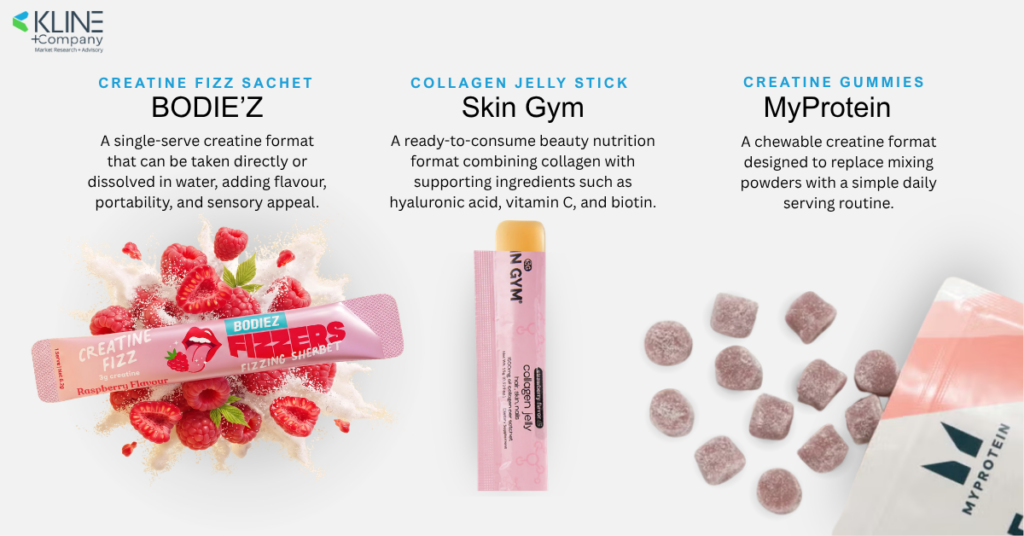
Image: A new generation of supplement formats is turning familiar ingredients into more convenient, sensory-led consumer experiences. Products featured; BODIE’Z’s Creatine Fizz, Skin Gym’s Strawberry Jelly Collagen stick and MyProtein’s Creatine gummies
In beauty nutrition, COSMAX NBT‘s jelly-stick capabilities and Skin Gym‘s strawberry collagen jelly stick show a ready-to-consume approach. BetterYou offers vitamin D oral sprays, while Nourished uses 3D printing to layer seven personalised nutrients into a single gummy stack.
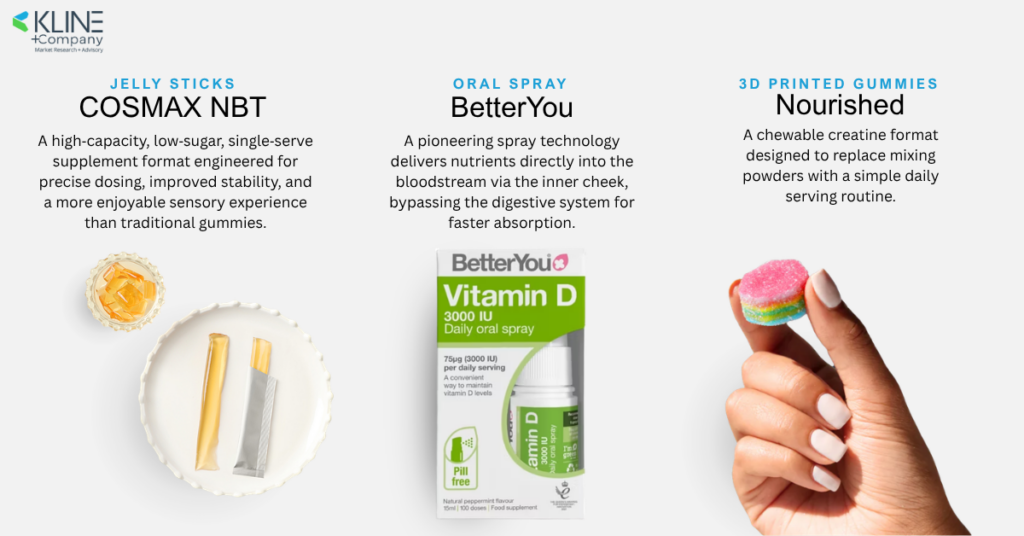
Image: Oral sprays and 3D-printed gummy stacks show how supplement formats are evolving around convenience, personalisation, and ease of use. Products featured; COSMAX NBT’S Jelly Sticks, BetterYou Oral Vitamin D Spray, and Nourished 3D Printed Gummies
These examples matter commercially for more than their appearance. Each changes some part of preparation, portioning, sensory experience or consumption, giving brands a different way to connect with their intended audience.
The Strongest Concepts Address a Specific Consumer Need
A format can be distinctive without making a product more useful. Its value depends on the audience and the barrier it addresses.
A consumer who dislikes tablets may welcome an oral spray. Someone looking for a portable option may favour an individual sachet. A ready-to-consume jelly may appeal to consumers who prefer not to measure and mix powders.
For brands, the starting point should be a clear understanding of the intended consumer: when they will use the product, what they find inconvenient and which parts of the experience influence their choice.
Confectionery-inspired packaging may attract attention, but the product still needs to communicate its purpose, serving instructions and value clearly.
Sensory Appeal Brings New Formulation Demands
As supplements take on more food-like experiences, taste and texture become central to product development.
A jelly stick needs an acceptable gel structure and flavour at the intended active dose. A gummy needs to balance ingredient loading with a practical serving size and chew experience. A fizzing powder needs its sensory effect to work alongside the functional ingredients.
For manufacturers, these requirements sit alongside processing compatibility, packaging performance and stability throughout shelf life.
This creates a role for suppliers of flavours, sweeteners, texturants and other supporting ingredients, whose performance can be critical to finished-product quality.
Early collaboration across the ingredient system can reveal constraints before the format, serving size and claims are fixed.
A Different Format Changes the Commercial Equation
Format decisions can influence production complexity, packaging costs, serving economics and price positioning.
Individual portions may support convenience while increasing packaging requirements. A distinctive texture may require additional development work. The intended dose may need several units: Myprotein’s UK creatine gummies, for example, contain 1g each, so a 3g daily serving takes three gummies. That affects both the consumer experience and the cost per serving.
Businesses also need to consider what consumers will compare a product with. A supplement with snack-like presentation may invite different expectations around flavour, convenience and price from a conventional capsule product.
Commercial evaluation should therefore connect the ingredient proposition with the finished product, its competitive context and the economics of continued use.
Where Should Ingredient Businesses Focus Next?
For ingredient suppliers and manufacturers, success will depend on identifying where their capabilities can support commercially viable applications, rather than pursuing every emerging format.
Technical feasibility is only one part of that assessment. Understanding category demand, competitive activity and market positioning is equally important when deciding which concepts deserve investment.
Application guidance, prototypes, compatibility information and stability evidence can help businesses determine where their ingredients are best suited. Combined with market intelligence, these insights provide a stronger basis for prioritising development and identifying opportunities for growth.
Kline and Company’s Food and Nutrition intelligence helps businesses evaluate demand, competition and portfolio fit, supporting more informed decisions about where to focus their resources.